Madrid turns into a game today. This private offline city quest uses app prompts to steer you through classic and lesser-noticed corners of central Madrid, with the Don Quixote theme doing the heavy lifting instead of a lecture. You’ll cover a 2-hour route from Plaza Mayor area toward Plaza de Santa Ana, and I like that you can start whenever you want and pause for breaks whenever you need.
I also like how the game ties famous Golden Age names to real streets and buildings. You’ll run into Cervantes-related stops (including the writer’s childhood home museum), plus Lope de Vega’s house-museum and the 16th-century Iglesia de San Sebastián on Atocha Street. One thing to consider: the experience depends on following the instructions in the app, so if construction or temporary changes affect sidewalks, you may need to use common sense to find the next spot.
In This Review
- Key highlights you should know before you go
- What this Don Quixote Quest is like on the street
- Price and value: $8.40 per person for a 2-hour app adventure
- Where you start, where you finish, and how to think about timing
- Stop 1: Plaza Mayor, your puzzle-launch point
- Puerta Cerrada and the vanished wall gate of medieval Madrid
- A 1926 square shaped by customs, guilds, and the Treasury
- Iglesia de San Sebastián on Atocha Street: look for the devotional route link
- Lope de Vega’s House-Museum: the writer’s home becomes the clue
- Cervantes childhood home museum: customs, books, and activities
- Cervantes’ burial puzzle: from 1616 to a 2015 forensic discovery
- Plaza de Santa Ana: monuments, terraces, and a proper place to regroup
- Practical tips so the app game feels smooth
- Who should book the Don Quixote Quest in Madrid
- Should you book the Don Quixote Quest in Madrid?
- FAQ
- How long does the Don Quixote Quest take?
- How much does the experience cost?
- Do I need internet to play?
- Is this a private experience or a shared tour?
- Is there a physical tour guide included?
- Where does the quest start and end?
- Can I start at any time?
- Is it free for kids?
- Is the experience available every day?
- What is the cancellation policy?
Key highlights you should know before you go
- Offline play means less stress: You don’t need internet to follow the game prompts.
- Private and flexible: It’s just your group, and you can start at any hour and take breaks.
- Priced for real value: At $8.40 per person, you’re paying for a self-guided game + mobile ticket, not a full escort.
- You’ll learn Madrid through authors: The route is built around places connected to Cervantes, Lope de Vega, and other Spanish literary figures.
- Designed for friends and families: Challenges make it easier to stay engaged together than a standard walking tour.
- Construction can throw off directions: Some guidance may not match the street scene if work is underway.
What this Don Quixote Quest is like on the street
This is a game-meets-walk in the center of Madrid. You download the apps, then follow on-screen prompts that tell you when to look around, find a detail, and answer a challenge to move forward. The idea is that you get the structure of a guided tour, but with the freedom of independent travel.
Since it’s offline, you can keep moving without hunting for cell signal every few minutes. And since there’s no physical guide included, the app does the talking. That can be a plus if you like control over your pace, and a drawback if you prefer someone to correct you or explain context on the fly.
Also, it’s set up for a group format. It’s billed as private for just your group, so you can play together, split up briefly to spot details, and then reunite at each checkpoint.
You can also read our reviews of more tours and experiences in Madrid.



Price and value: $8.40 per person for a 2-hour app adventure
At $8.40 per person, you’re not paying for transportation or a person walking you around. You’re paying for the route, the app-based challenges, and the mobile ticket experience.
So the real “value question” is: will you enjoy spending about two hours doing clue-finding on foot? If yes, the price makes sense because you’re getting a structured itinerary through major central areas like Plaza Mayor and the route that leads you toward Plaza de Santa Ana.
If you want a narrated tour—someone to translate architecture, explain history in detail, and answer questions instantly—this might feel light. The experience gives you prompts and destinations, but you’re the interpreter here.
Where you start, where you finish, and how to think about timing
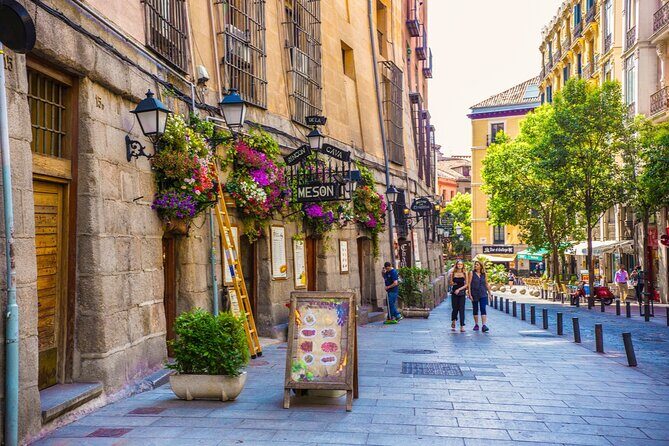
You start at C. del Marqués Viudo de Pontejos, 17, Centro, 28012 Madrid, Spain. You’ll finish at C. del Príncipe, 2, Centro, 28012 Madrid, Spain. The game ends in the middle of Plaza de Sta. Ana, guided by the instructions inside the app.
The route is meant to take about 2 hours, but they also note you can take your time. That’s important in Madrid, because you’ll likely pause to look closely at plaques, shop fronts, and church exteriors—and you’ll probably want a coffee mid-game.
One more detail that matters: the experience is always available to book, and it’s described as open 24/7. Practically, you can pick a time that fits your energy level—morning for calmer streets, late afternoon if you like the city at golden-hour pace.
Stop 1: Plaza Mayor, your puzzle-launch point
Your first major anchor is Plaza Mayor, the big central public square in old Madrid. It’s described as the heart of Old Madrid, built during the reign of Philip III, and just a few blocks from Puerta del Sol.
What you do here is classic quest behavior: you look around to find an answer to the challenge and learn the story of the place. Even if you’ve seen Plaza Mayor in photos, the game format helps you pay attention to the small cues you might otherwise ignore—signage, layout, and historical references built into the square’s atmosphere.
Practical note: give yourself a little extra time at the start. Early momentum matters, because you’ll be getting used to how the prompts work.
Puerta Cerrada and the vanished wall gate of medieval Madrid
One of the stops focuses on Puerta Cerrada, a gate name tied to Madrid’s Christian wall during the Middle Ages and Renaissance. The experience notes that Puerta Cerrada was opened at that time, then demolished in 1569 during Isabel de Valois’s entry into the city (she was Felipe II’s wife).
This is a smart choice for a city game, because it turns an idea—an old city wall and gate—into something you can actually hunt for visually. Instead of reading a museum label, you’re actively scanning the surroundings for the clue that matches the story.
The payoff: you come away with a clearer mental map of how Madrid’s urban shape shifted over centuries, even if the wall itself isn’t still standing like a movie set.






A 1926 square shaped by customs, guilds, and the Treasury
Another checkpoint takes you to a square created in 1926 after demolitions around the old customs area and a nearby square linked to La Leña (and Calle de la Bolsa). It also references the demolition of buildings including the Convent of the Trinitarios Calzados and the fish market of Almidón.
Then the story shifts into finance and power: it notes that the palace of the Five Major Guilds, built in the 17th century by Manuel de la Ballina, later became the property of the Bank of Isabel II. When that bank merged with the bank of San Carlos, it gave rise to the first headquarters of the Bank of Spain. In the early 21st century, the building is tied to the General Directorate of the Treasury.
Even if you’re not a banking-history buff, this kind of stop is useful because Madrid’s center is full of layers like this. The game nudges you to notice the building’s role in different eras, not just its façade.
Possible drawback: since the stop’s description is packed with details, you might want to slow down and read carefully when the app prompts you. If you just rush for answers, you’ll miss the “aha” moment.
Iglesia de San Sebastián on Atocha Street: look for the devotional route link
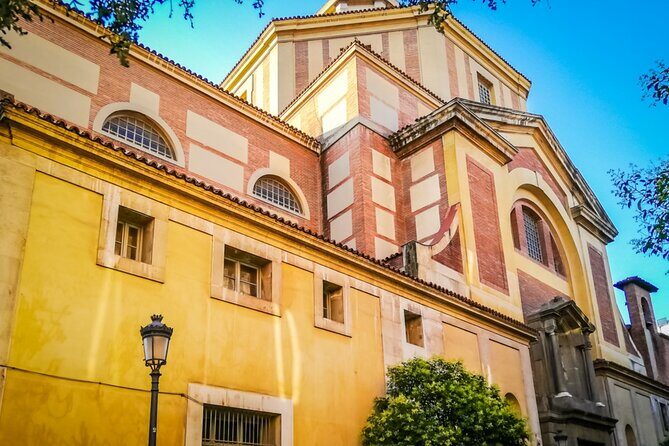
Next up is Iglesia de San Sebastián, a 16th-century church on Atocha Street, #39. The experience explains the name comes from a devotional chapel found along the route to the Basilica of Nuestra Señora de Atocha, which was founded in 1541.
This is a neat stop because it connects two locations through the idea of pilgrimage routes. You’re not just looking at a church; you’re looking at why that church mattered to travelers moving through the city.
For the game, you’ll again look around to find the right answer and move onward. For you, the win is that you learn a practical piece of urban logic: religious sites weren’t random; they lined up with movement patterns across Madrid.
Lope de Vega’s House-Museum: the writer’s home becomes the clue
The route includes the House-Museum of Lope de Vega, described as Lope de Vega’s former home. The house is called a 16th-century structure, and it notes that Lope de Vega bought it in 1610.
This stop works well for a quest because it keeps the theme grounded. You’re walking toward a specific place tied to a specific person, which makes the game feel less generic than “walk and scan.”
When the app prompts you to search for the clue, you’ll be forced to slow down just enough to register details you might otherwise miss in a doorway or façade. Even a quick look can feel different when you know the building is literally connected to the person who shaped Spain’s Golden Age drama.
Cervantes childhood home museum: customs, books, and activities
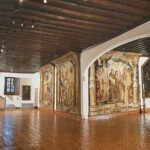
One of the strongest points on the route is the childhood home of Miguel de Cervantes Saavedra, now a museum dedicated to him. The experience describes it as recreating the customs, traditions, and everyday life of the 16th and 17th centuries.
It also notes something useful for book lovers: the museum houses an important bibliographic collection with editions of Cervantes’s work from different periods and in different languages, shown in a temporary exhibition room. The stop description adds that there’s a consolidated programme of activities such as workshops for children and teenagers, conferences, plays, and musical shows.
How does this fit with a game? The app pushes you to learn one story piece at a time. If you’re the type who likes to follow a theme, this is where you’ll feel the route clicking into place: Cervantes isn’t just a name on a postcard. You’re in a space built to make his world tangible.
Tip: if you enjoy museums, you’ll likely want extra time here. The quest can take about two hours total, but the museum itself invites deeper lingering.
Cervantes’ burial puzzle: from 1616 to a 2015 forensic discovery
Another checkpoint ties the Cervantes theme to his remains. The experience says Miguel de Cervantes was buried at a convent in 1616. It notes his remains were temporarily transferred elsewhere in 1673 during rebuilding, then lost until forensic scientists discovered them in 2015.
This stop is a great example of why the quest format is fun. It gives you a human story twist—an actual mystery and a modern science payoff—without turning your walking day into a timeline lecture.
Even if you don’t absorb every date, you’ll walk away remembering the main idea: history doesn’t always stay fixed. Sometimes it gets re-found.
Plaza de Santa Ana: monuments, terraces, and a proper place to regroup
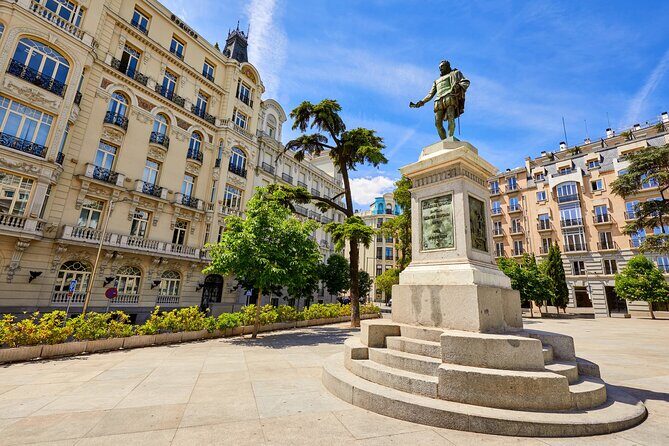
Your game ultimately ends around Plaza de Sta. Ana, a square packed with the Spanish literary scene in stone. The experience describes monuments to Pedro Calderón de la Barca and Federico García Lorca, plus lots of restaurants, cafes, and tapas bars.
It also notes that terraces cover much of the sides surfaces. That matters, because Plaza de Santa Ana is one of those Madrid locations where a break feels natural. After two hours of clue-solving, you’ll likely be hungry or at least ready to people-watch.
Since the game ends in the middle of the plaza, you get a built-in moment to check your progress, review your answers, and decide if you’re done—or if you want to keep wandering on your own.
Practical tips so the app game feels smooth
Here’s what you should plan for, based on how this quest is set up:
- Bring comfy shoes. You’re doing a walking route with repeated look-around moments.
- Expect a little extra time. The tour is about two hours, but you can take your time, and Madrid rewards slow movement.
- Use the app prompts, not guesswork. The entire flow depends on the next challenge unlocking the next location.
- Assume construction can affect the route. One real note of caution: instructions may not match the street scene if work is underway, so stay flexible.
- Don’t rely on mobile data. Since you can play offline, you’re better off planning on offline operation rather than chasing signal.
Also, it’s near public transportation, so if your feet get tired, you can break and hop to a nearby stop. And service animals are allowed. The experience says most travelers can participate, which usually means the walking is manageable for many visitors.
Who should book the Don Quixote Quest in Madrid
This quest is especially good if you fit one of these profiles:
- Families and mixed-age groups who want an activity that keeps everyone engaged without needing a full schedule of museum stops.
- Friends traveling together who like a challenge and don’t mind reading clues as you walk.
- First-timers who want structure but still want freedom and not constant narration.
- Residents of Madrid who want a different way to see familiar places and get pointed toward details you may have skipped.
If you want a traditional, talk-your-way-through-it guided tour with lots of spoken explanations, you might find this too self-directed. But if you enjoy discovery-by-doing, it’s a great fit.
Should you book the Don Quixote Quest in Madrid?
If you’re looking for a low-cost, offline, self-guided way to see central Madrid, I’d recommend it. The route hits major reference points like Plaza Mayor and Plaza de Santa Ana, and it links them to famous Spanish writers and real places tied to Cervantes and Lope de Vega.
Book it if you’re the type who likes interactive sightseeing and can handle occasional rerouting if the city changes temporarily. Skip it if you strongly prefer a live guide to handle confusion fast and provide full context without you reading along.
Overall, it’s a smart value play: you’re paying for an experience that turns sightseeing into a game, for about two hours, with the flexibility to start when your day actually works.
FAQ
How long does the Don Quixote Quest take?
It’s approximately 2 hours, and you can take your time during the game.
How much does the experience cost?
It costs $8.40 per person.
Do I need internet to play?
No. The game can be played offline, so you do not need an internet connection.
Is this a private experience or a shared tour?
It’s private. Only your group participates.
Is there a physical tour guide included?
No. A physical tour guide is not included.
Where does the quest start and end?
You start at C. del Marqués Viudo de Pontejos, 17, Centro, 28012 Madrid, Spain. The game ends in the middle of Plaza de Sta. Ana, and you finish at C. del Príncipe, 2, Centro, 28012 Madrid, Spain.
Can I start at any time?
Yes. You have full flexibility and can start at any hour.
Is it free for kids?
Yes. It’s free for kids.
Is the experience available every day?
It’s described as always available to book and open 24/7, every day of the week. Listed opening hours show 12:00 AM to 11:59 PM Monday–Saturday.
What is the cancellation policy?
You can cancel for a full refund up to 24 hours before the experience start time. If you cancel less than 24 hours before the start time, the amount paid is not refunded.