REVIEW · MADRID
Madrid: All in One Sightseeing city tour (3 hours)
Book on GetYourGuide →Operated by Madrid Tuk Tours · Bookable on GetYourGuide
Madrid has a knack for surprising you. A tuk-tuk helps that happen fast. I like this tour because it strings together old Madrid of the Austrias with major modern landmarks in just 3 hours, and the stops are designed for variety. I also like the hands-on feel: you’re in motion on a comfortable eco-friendly six-seat tuk-tuk with a guide who keeps the story going in multiple languages. One drawback to plan around: the tour isn’t suitable for wheelchair users, and kids under 6 can’t be transported.
If you care about getting your bearings quickly, this one is a good bet. The route starts near Madrid Opera, then works its way through historic squares, a top market stop, and famous streets like Gran Vía. In the tour stories I’ve seen from guides such as Cesar and Gerardo, the best part is the mix of monument facts plus local “how people actually live here” context.
In This Review
- The Quick Pitch: What This 3-Hour Madrid Tuk-Tuk Tour Does Well
- Price and Value: $170 Per Group Up to 6
- Getting to the Start: Next to Madrid Opera
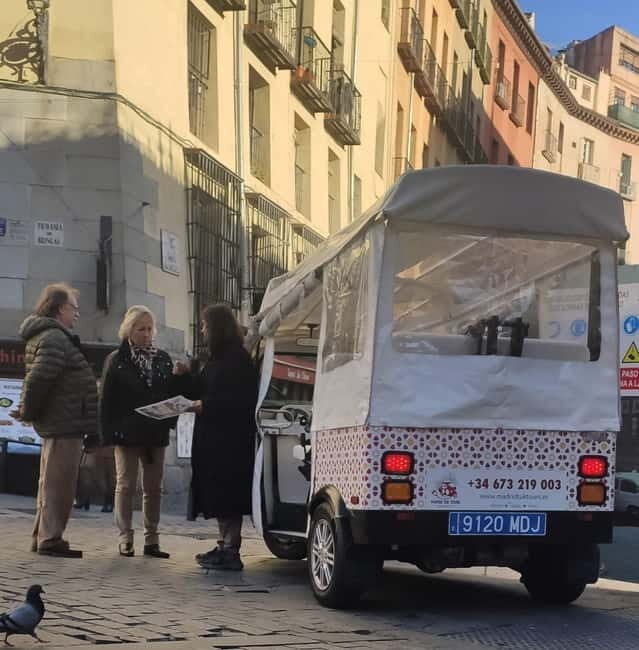
- Touring in an Ecological Six-Seat Tuk-Tuk
- Stop 1: C. de Vergara, 1 and the Opera Area Setup
- Stop 2: Palacio Madrid Photo Stop
- Stop 3: Plaza de la Villa Sightseeing
- Stop 4: Market of San Miguel Guided Tour
- Stop 5: La Latina Neighborhood Guided Tour
- Stop 6: Las Letras Quarter Sightseeing
- Stop 7: Congress of Deputies Sightseeing
- Stop 8: Plaza de Cibeles Guided Tour
- Stop 9: Gran Via Sightseeing
- Stop 10: Back to C. de Vergara, 1
- Guides Make the Difference: Cesar, Gerardo, and the Local Touch
- Who This Tour Fits Best
- Weather, Comfort, and Practical Tips
- Cancellation and Flexibility (Quick Note)
- Should You Book This Madrid All-in-One Tuk-Tuk Tour?
- FAQ
- How long is the Madrid tuk-tuk sightseeing tour?
- Where does the tour start and end?
- What languages are offered on the tour?
- Is this a private group tour?
- What is the price for the tour?
- Is the tour suitable for children or wheelchair users?
The Quick Pitch: What This 3-Hour Madrid Tuk-Tuk Tour Does Well

This is a compact city tour built for real pacing. You get comfortable transport in a small group setting, plus a guide who helps you connect what you see to why it matters. It’s not a “stand and stare” experience; it’s more like a guided walk, just with less legwork and more sliding past viewpoints.
You’ll also get a private-group feel, which matters in Madrid. Big buses and big groups can turn a “great plan” into a slow shuffle. With a small group and a focused guide, you’re more likely to enjoy the streets instead of just surviving them.
Price and Value: $170 Per Group Up to 6

At $170 per group (up to 6 people) for about 3 hours, the math gets reasonable fast if you can fill the group. If you’re booking as a couple, it may feel a bit pricey compared with a standard group sightseeing option. But it includes transport in a comfortable eco-friendly tuk-tuk plus an exclusive multilingual local guide, which is the real value piece.
Think of it like this: you’re paying for convenience and narrative. Instead of navigating multiple neighborhoods alone (with the risk of missing the “why”), you’re riding a planned route where the guide points out the stories behind the monuments and beautiful sites.
You can also read our reviews of more city tours in Madrid



Getting to the Start: Next to Madrid Opera

The tour meets at C. de Vergara, 1. Practically speaking, it’s right by Madrid Opera, about 20 meters from the Opera metro station. That’s useful because “close to a metro” means fewer headaches at the start.
If you arrive early, you’ll have time to locate the starting point and get everyone settled before you roll out. The route ends back at the same meeting point, so you’re not left stranded halfway across town.
Touring in an Ecological Six-Seat Tuk-Tuk
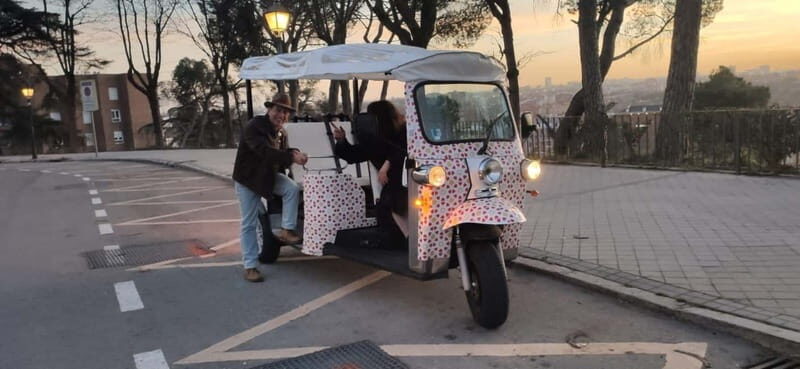
You’re traveling in six-seat ecological tuk-tuks, and that small size makes a difference. Narrow streets feel less like obstacles and more like part of the route. The tuk-tuks are also described as clean and equipped with rain covers, which is handy when Madrid weather decides to do its own thing.
This matters because the city’s rhythm changes block by block. A car or bus can make you feel like a passenger. A tuk-tuk keeps you closer to the street level, which helps you notice details the guide points out.
Stop 1: C. de Vergara, 1 and the Opera Area Setup
The meeting point is in a prime “launch zone.” You’re near major transport (Opera metro), so you can meet your group smoothly and start on time. From here, the tour can shape the rest of your visit: you don’t waste the first part of your sightseeing time figuring out where to go.
You’ll likely get an early orientation from your guide too—enough to understand the historical thread you’re about to follow.
Stop 2: Palacio Madrid Photo Stop
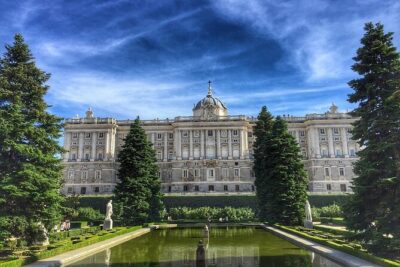
This is your “glance and understand” moment. A photo stop sounds quick—because it is—but it works as a warm-up for the larger story of monarchy-era Madrid.
Why it’s worth even a short stop: seeing palace architecture early in the tour gives you context for what follows. When you continue to squares and neighborhoods, the guide can connect the dots between power, urban design, and everyday life.
Tip: treat this stop like you would a museum intro plaque. Take a couple photos, then let the guide explain what you’re actually looking at. That’s where the value hides.
You can also read our reviews of more tours and experiences in Madrid




Stop 3: Plaza de la Villa Sightseeing
Plaza de la Villa is the kind of stop that helps you feel the “Madrid of the Austrias” idea in real space. It’s the sort of square where you can understand why Philip II decided to install his court in the city in 1561—and why that decision shaped the oldest buildings and monuments we still see.
Squares like this are also where the guide’s narrative becomes useful. Instead of listing dates, a good guide points out how the built environment reflects governance, religion, and civic life.
Possible drawback: since this is sightseeing time inside a historic core, expect cobblestones and busy street crossings. Wear shoes that don’t punish you.
Stop 4: Market of San Miguel Guided Tour

The Market of San Miguel is your “Madrid tastes and textures” stop. Even if you don’t plan to buy food on the spot, a guided look helps you read the scene: what it is, how it functions, and how markets fit into local daily life.
This is also a smart break in the tour’s flow. After palace-and-square history, a market stop gives you a different kind of sensory information—what people gather for, what the area means socially, and how tradition mixes with modern Madrid.
Practical note: bring cash if you like the idea of tasting things, but keep your plans flexible. If you’d rather just observe, that still works.
Stop 5: La Latina Neighborhood Guided Tour
La Latina is where the tour shifts from formal monuments to lived-in Madrid. A guided visit here is valuable because it can explain the neighborhood’s character without turning it into a generic “photo opportunity” zone.
The strongest part of a neighborhood stop is when your guide connects architecture to street life. In La Latina, that connection tends to feel natural—because the streets themselves tell you the story of how people have moved through this area for generations.
What to watch: the guided portion can mean more time walking than you’d expect if you only signed up for a tuk-tuk ride. If you’re traveling with someone who hates walking, make sure they’re up for short stretches.
Stop 6: Las Letras Quarter Sightseeing
Las Letras is a great name for a stop because it signals a theme—Madrid’s culture and literary identity—without needing you to be an expert. “Sightseeing” here works like a guided lens: you look, your guide explains, and you start seeing Madrid as more than a set of famous landmarks.
This is a good mid-tour checkpoint. By now, you’ve gotten the early historic setup and a market-neighborhood contrast. Las Letras can be the bridge to the tour’s later big-city sights like Congress and Gran Vía.
Stop 7: Congress of Deputies Sightseeing
This is where Madrid shows its political face. Seeing the Congress area after older squares helps your brain do something useful: compare how power looks across eras.
Even if you only get a short sightseeing moment, the point isn’t deep study. It’s context—how the city evolved from Philip II’s court era into a modern capital where politics sits in plain view.
Practical tip: this stop is an ideal time to ask your guide one of those big-picture questions: How does Madrid organize its public spaces? Where do people gather? A guide can turn a quick look into something you’ll remember.
Stop 8: Plaza de Cibeles Guided Tour
Plaza de Cibeles is a classic landmark moment, the kind that makes you feel like you’ve arrived in “main Madrid.” A guided stop here helps you understand why the plaza matters visually and historically.
What I like about placing Plaza de Cibeles in the later part of the tour: by then, you’re not just taking in a big monument. You’re reading it. You’re noticing how earlier historic themes (power, city planning, major public spaces) show up again in a more recognizable modern form.
This stop also gives you a clean visual contrast before the grand finale street moment.
Stop 9: Gran Via Sightseeing
Gran Vía is the tour’s “big street” payoff. Even if you’ve seen it in photos, being guided through it changes your experience. A guide can point out why this avenue became such an important part of Madrid’s identity—especially as the city shifted toward modern life.
It’s a smart place to end your sightseeing arc, because Gran Vía gives you wide views and a sense of momentum. When you finish and head back to C. de Vergara, it feels like you completed a whole loop: old Madrid roots → civic spaces → market and neighborhoods → modern capital energy.
Stop 10: Back to C. de Vergara, 1
Ending right where you started is underrated. It keeps the experience smooth, and it prevents that last-hour scramble that can happen when tours end in a random square you have to “figure out” afterward.
You can also keep your evening plans simple. If you want dinner nearby, you’re in a central, metro-friendly area.
Guides Make the Difference: Cesar, Gerardo, and the Local Touch
The best reviews I’ve seen emphasize the same thing: the guide doesn’t just recite facts. When guides like Cesar or Gerardo are running the tour, you get a friendly, professional explanation of the monuments you pass, plus practical local tips you can use right away.
That matters because Madrid is a city where a little context goes a long way. A guide turns a building into a story and a street into a place with meaning.
Who This Tour Fits Best
This is a strong choice if:
- You want a single tour that hits both classic Madrid and major landmarks in 3 hours
- You value being guided in English, French, Portuguese, or Spanish
- You’d rather ride in a small six-seat eco tuk-tuk than handle multiple transit legs
It may not be ideal if:
- You use a wheelchair (the tour isn’t suitable)
- You’re traveling with children under 6 (transport isn’t possible due to legal requirements)
- You want a super long, slow museum-style experience with lots of extended stops
Weather, Comfort, and Practical Tips
Madrid can surprise you. The tuk-tuks come with rain covers, which helps if the sky opens up while you’re out. Still, dress for walking and bring a layer if it feels cool.
Also, plan for photo moments. The itinerary includes a Palacio Madrid photo stop, plus sightseeing segments. That means you’ll have chances to capture the big views, but it won’t be a “photos only” tour—so don’t expect long free time at each stop.
Cancellation and Flexibility (Quick Note)
If your plans might change, the tour includes free cancellation up to 24 hours in advance for a full refund, and there’s a reserve now & pay later option. That’s useful if you’re still timing the rest of your Madrid days.
Should You Book This Madrid All-in-One Tuk-Tuk Tour?
I’d book it if you want a smart first-Madrid move or a high-efficiency day in the city. The biggest strengths are the private-group feel, the eco-friendly tuk-tuk comfort, and the way the route covers different sides of Madrid—history, markets, neighborhoods, and modern landmarks—without dragging.
Skip it if mobility access is a concern for your group or if your ideal pace is slow and lingering with lots of time inside sites. For everyone else, this tour is a practical way to get your bearings fast and leave with a clearer sense of how Madrid connects its past and present in real streets, not just in guidebook blurbs.
FAQ
How long is the Madrid tuk-tuk sightseeing tour?
It lasts 3 hours.
Where does the tour start and end?
It starts at C. de Vergara, 1, next to Madrid Opera (about 20 meters from Opera metro station) and ends back at the same meeting point.
What languages are offered on the tour?
The live guide is available in English, French, Portuguese, and Spanish.
Is this a private group tour?
Yes, it’s listed as a private group.
What is the price for the tour?
The price is $170 per group, up to 6 people.
Is the tour suitable for children or wheelchair users?
It’s not suitable for children under 6, and it’s also not suitable for wheelchair users.