REVIEW · MADRID
Madrid Tuk Tuk Welcoming Tour
Book on GetYourGuide →Operated by Tuktuk Limo Tours · Bookable on GetYourGuide
Madrid by tuk tuk feels like a moving postcard.
In just 2 hours, you roll through central Madrid on an electric tuk tuk and stop often enough to take photos without feeling like you are sprinting. I like the mix of photo-friendly stops and storyteller-style narration, including details like Pedro Calderón de la Barca’s connection to Calle Mayor 90.
Second, I’m a fan of how the ride strings together famous landmarks with smaller streets and food-town stops you might otherwise miss. If you get a guide like Miguel or Yonnathan, the commentary can make the city click fast. One drawback to plan for: stops are short, and a couple past booking issues point to a real risk of audio/language mismatch, so you should manage your expectations and confirm the guide language if it’s important to you.
In This Review
- Key takeaways before you book a Madrid tuk tuk welcome tour
- Why Madrid makes sense for a tuk tuk welcome tour
- The 120-minute pace: what those quick stops really mean
- Starting at Calle Mayor 90: the photo stop that sets the tone
- San Miguel Market and Botín: food Madrid without waiting all day
- Cava Baja: tapas street history in a few minutes
- Royal Basilica of San Francisco el Grande: a big interior you see from the outside
- Puerta de Toledo area and Atocha: where Madrid’s layers meet
- Retiro Park and Alcalá Gate: classic Madrid walks and grand urban lines
- Las Ventas and Bernabéu: sports icons with a sense of theater
- Paseo de la Castellana and Gran Vía: the modern Madrid sweep
- Plaza de España, Temple of Debod, Royal Palace, and Plaza de Oriente: the final “wow” sequence
- Ópera Station and Almudena Cathedral: the ending that ties old and new together
- The one thing I’d double-check: language and audio clarity
- Who this tour is best for (and who should skip it)
- Price and value: how $187 per group up to 4 can work out
- Should you book the Madrid Tuk Tuk Welcoming Tour?
- FAQ
- How much does the Madrid Tuk Tuk Welcoming Tour cost?
- How long is the tour?
- Where is the meeting point?
- Is this a private tour?
- What languages are available?
- Is the tour wheelchair accessible?
- What’s included in the price?
- Does the tour include a skip-the-ticket-line benefit?
- Is free cancellation available?
- Is reserve now and pay later available?
Key takeaways before you book a Madrid tuk tuk welcome tour
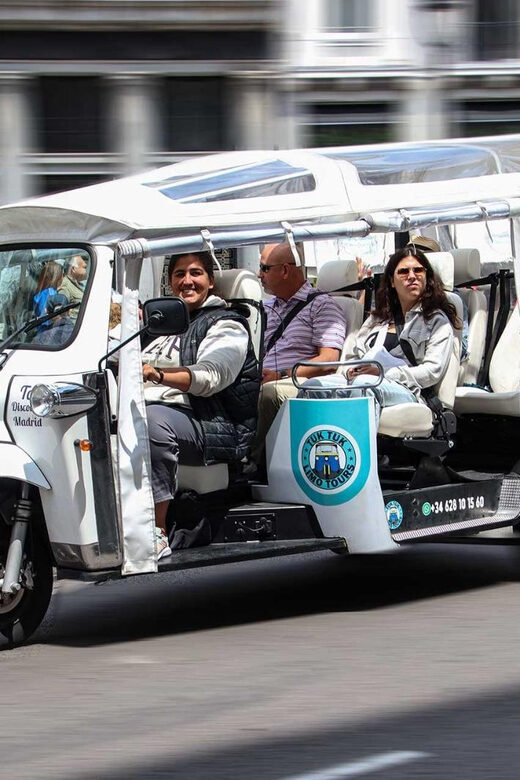
- Electric tuk tuk, lots of stops: You cover far more ground in 120 minutes than walking.
- Old Madrid to royal Madrid in one loop: From Calle Mayor to the Royal Palace area, it’s a quick sampler.
- Food and neighborhood flavor: San Miguel Market, Sobrino de Botín, and Cava Baja all bring the city’s daily life into the plan.
- Big-name sights without the long transit stress: Atocha Station, Retiro, Las Ventas, Bernabéu, and Gran Vía are on the route.
- Ancient to modern in one ride: Temple of Debod sits in the middle of the city’s modern axes.
- Language and hearing are the watch-outs: You’ll want to be close enough to hear and to match your preferred language.
Why Madrid makes sense for a tuk tuk welcome tour
Madrid is huge in attitude and spread out on the map. Even if you are staying near the center, getting a feel for distances can take a lot of time on foot and metro waits. A tuk tuk welcome tour solves that with one simple trick: it moves you smoothly between neighborhoods while a guide helps you translate what you are seeing.
The electric part matters too. You are not stuck in the noise and exhaust you can get with older vehicle styles, and the ride feels lighter. You also get that stop-and-go rhythm that works well in Madrid, where many of the best viewpoints are just a short walk away from a main road.
Finally, this tour is built around orientation. It is not just “look at this building.” It’s more like, “here’s how the city is organized, why people gather here, and how each place connects to the next.” If you like arriving in a new city already knowing where the big districts sit, this kind of overview is useful.
You can also read our reviews of more tours and experiences in Madrid.

The 120-minute pace: what those quick stops really mean
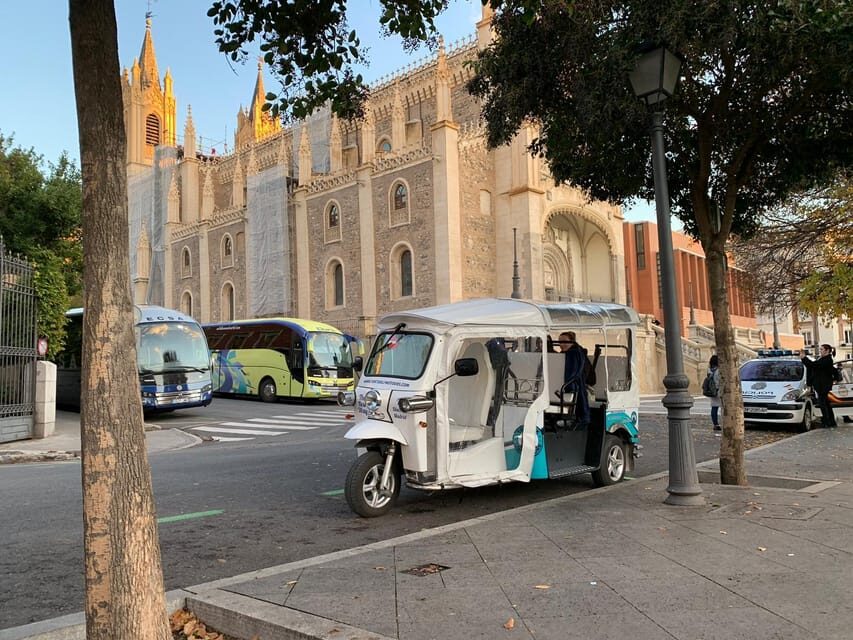
Most stops are short photo visits, around five minutes each. That means you get snapshots and context, not a deep visit. Think of the tuk tuk as your city decoder ring: you’ll learn what things are, where they are, and what to look for later when you have time to slow down.
This also changes what kind of traveler you should be. If you want to sit inside the palace for hours or tour museums with full attention, this won’t replace those plans. But if your goal is to connect dots fast, you will leave with a mental map that makes the rest of your days easier.
One practical thing I advise: take photos, yes, but also look up. From the tuk tuk you are often level with signage, facades, and grand urban lines. If you only shoot, you miss the street-level clues like where people queue for food, how plazas are shaped, and how boulevards steer the traffic flow.
Starting at Calle Mayor 90: the photo stop that sets the tone
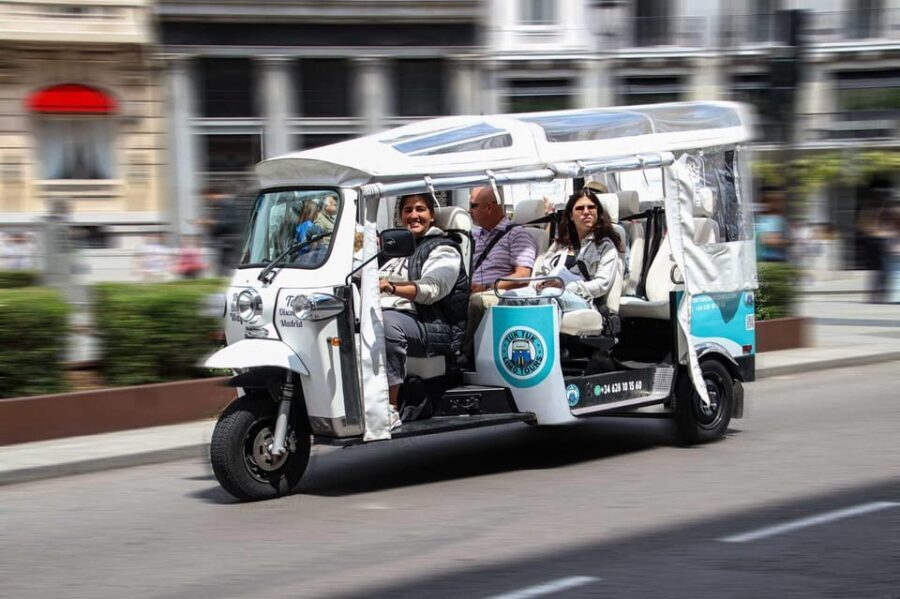
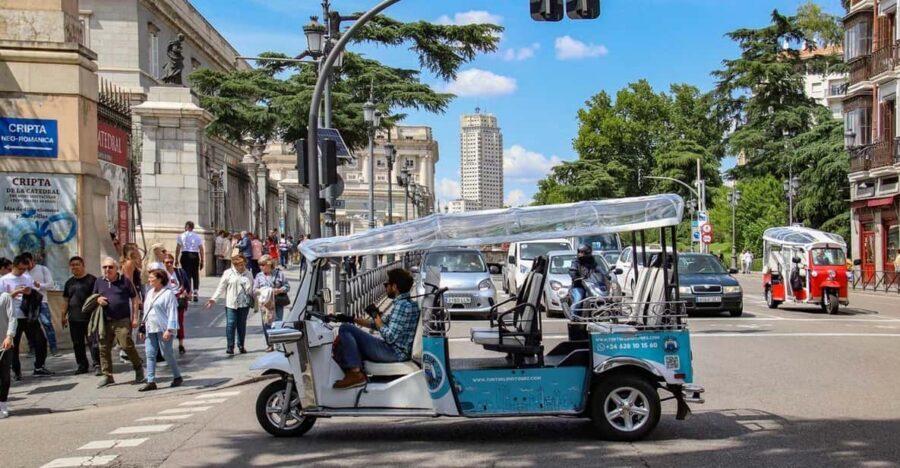
You begin at C. Mayor 90, near the Cripta de Almudena area. It is a smart starting point because Calle Mayor is classic Madrid: pedestrian-focused streets, old-town energy, and historic corners packed closely together.
The tour includes a photo stop on Calle Mayor, with a specific story tied to Pedro Calderón de la Barca, the playwright who lived there. That kind of detail is more than trivia. It helps you understand why this area feels like Spain on stage—language, theater, and old power centers all leave marks.
Also, since you will return to Calle Mayor at the end, you get a full loop feeling. You’re not just dropped somewhere; you come back to the same familiar axis, which is great for orienting yourself later.
San Miguel Market and Botín: food Madrid without waiting all day
Next up is the Market of San Miguel. The guide points you to the market setting in one of the busiest squares near Puerta del Sol. Even if you do not spend much time inside, the stop is useful because it shows how Madrid’s food culture lives right on the main pedestrian routes.
The tour then moves you toward Sobrino de Botín, famous for being founded in 1725. This is the oldest restaurant in the world, and the story is exactly the kind of thing that changes how you see the street. You’ll start noticing how older institutions survived right through waves of modern Madrid.
One value angle here: you get food landmarks in a “first day” format. If you only ate where your feet took you, you might miss Botín’s legendary role. With a quick stop plus explanation, you’ll know what to seek later when you are ready for a longer meal.
Cava Baja: tapas street history in a few minutes
The tuk tuk spends a short stop in Cava Baja, an area that the tour description links to an old Arab hideout past. Today it’s known for bars, traditional restaurants, hostels, and flamenco bars packed into a maze of streets.
This stop works because it balances two things you need on day one. You get the nightlife map, and you get the reason behind the neighborhood’s layout and persistence. Cava Baja is the kind of place where later, when you’re deciding where to eat or listen to music, you already feel like you know the terrain.
Practical tip: if you want to keep the pace comfortable, use these short stops to photograph street corners and street names rather than aiming for a full wander. The guided rhythm keeps you from losing time in the fun chaos.



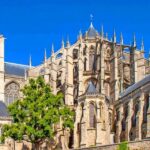

Royal Basilica of San Francisco el Grande: a big interior you see from the outside
The tour includes a photo stop at the Royal Basilica of Saint Francis the Great in La Latina. The key detail you should remember here is the timeline: the church has history dating back to the 13th century.
Even if your stop is brief, this is the kind of building where just seeing the massing tells you what kind of city Madrid has been. Madrid has always wanted grandeur, and basilicas like this show it in stone, not marketing.
If you like architecture, this is a good stop to save energy for. Later, if you decide to return for a more focused visit, you’ll know exactly what drew you here.
Puerta de Toledo area and Atocha: where Madrid’s layers meet
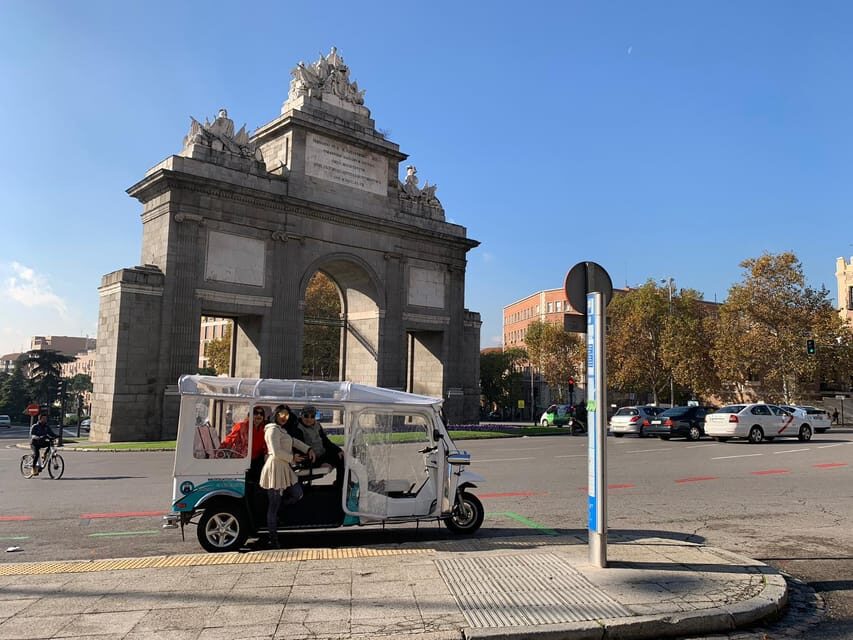
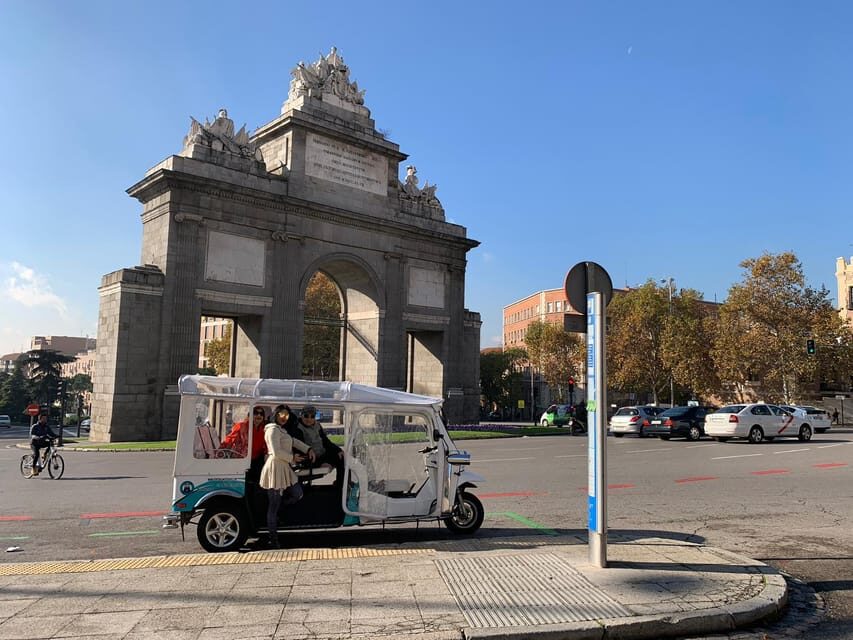
The plan includes the Glorieta de Toledo, including views tied to the Puerta de Toledo gateway from the 19th century. That matters because it’s not only a postcard arch. It’s a marker of how Madrid expanded and re-walled itself as the city grew.
From there, you head to Atocha Station, one of Spain’s busiest transport hubs. The description highlights a huge annual passenger figure: about 90 million. This stop is practical in a way few sightseeing tours get right. Atocha is where your train plans either go smoothly or become a stress test, so it helps to place it on your mental map early.
If you are planning day trips, this is a great moment to look around and decide where you’ll walk after your ride ends. Even a short exposure turns Atocha from a name on a ticket into an easy landmark.
Retiro Park and Alcalá Gate: classic Madrid walks and grand urban lines
You then reach Buen Retiro Park, a historic park with a pond, monuments, and the Crystal Palace connected to the reigns of Philip IV and Charles III. The stop is short, but it gives you the backbone of why Retiro is a Madrid lifestyle center, not just a scenic break.
Next is Alcalá Gate, built in 1778 and once Madrid’s main entrance. This stop is valuable because gates explain movement. You start to see Madrid as a city with clear thresholds: where it entered, where it expanded, and how later boulevards replaced old entry points.
Even if you only spend a few minutes at each, the contrast helps. Retiro gives you a slower, greener pause. Alcalá Gate snaps you back into the idea that Madrid always balances leisure with impressive scale.
Las Ventas and Bernabéu: sports icons with a sense of theater
A highlight stop is Las Ventas, described as one of the world’s most important bullrings and known for its monumental look. Even if bullfighting is not your scene, you’ll likely appreciate the architecture and the crowd-energy design the building represents.
Then comes Santiago Bernabéu Stadium, home to Real Madrid since 1947. This stop is more than a sports flex. It’s a way to understand Madrid’s modern identity: a city that still treats big events like national rituals.
Here’s how to get value from both stops. Don’t just photograph the exterior. Look for the way the roads and avenues channel people toward the venue. That gives you clues about where you’ll actually want to walk on event days, and where the main approaches are.
Paseo de la Castellana and Gran Vía: the modern Madrid sweep
The tour includes Paseo de la Castellana, a major thoroughfare lined with historic mansions and now home to embassies and cultural centers, plus a Museum of Public Art. This stretch is where the city starts feeling administrative and global.
Then you hit Gran Vía, Madrid’s iconic avenue known for its early skyscrapers and modern architecture as the city modernized. This is a great place to grab photos because Gran Vía frames the skyline and gives you a strong sense of straight-line urban planning.
If you’re the type who likes to picture how a city moves, this section helps. The guide’s job here is to connect what you see—street width, building styles, and traffic flow—to what it means for daily life.
Plaza de España, Temple of Debod, Royal Palace, and Plaza de Oriente: the final “wow” sequence
Now the tour starts stacking major landmarks that feel different from the boulevards. You stop at Plaza España, with the famous Cervantes Monument at the intersection of Gran Vía and Princesa streets. It’s an easy photo moment, but it’s also a mental anchor for where Spanish literature and national identity are put on display.
You also visit the Temple of Debod, an ancient Egyptian temple from the 2nd century BC relocated to Madrid’s Cuartel de la Montaña Park. This is one of those stops where the contrast is the point: ancient Egypt in the middle of Madrid, without it feeling random once you’re told the relocation story.
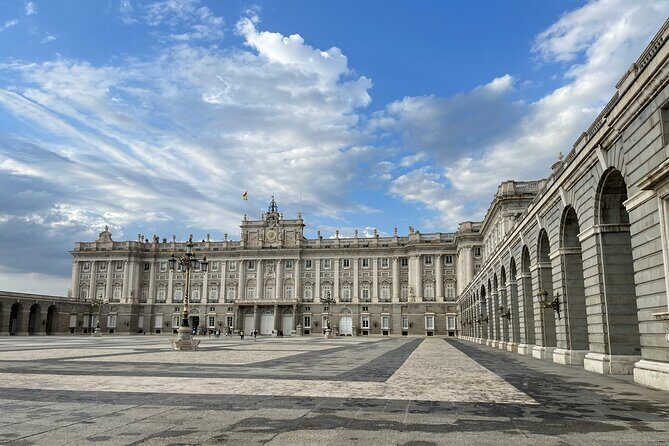
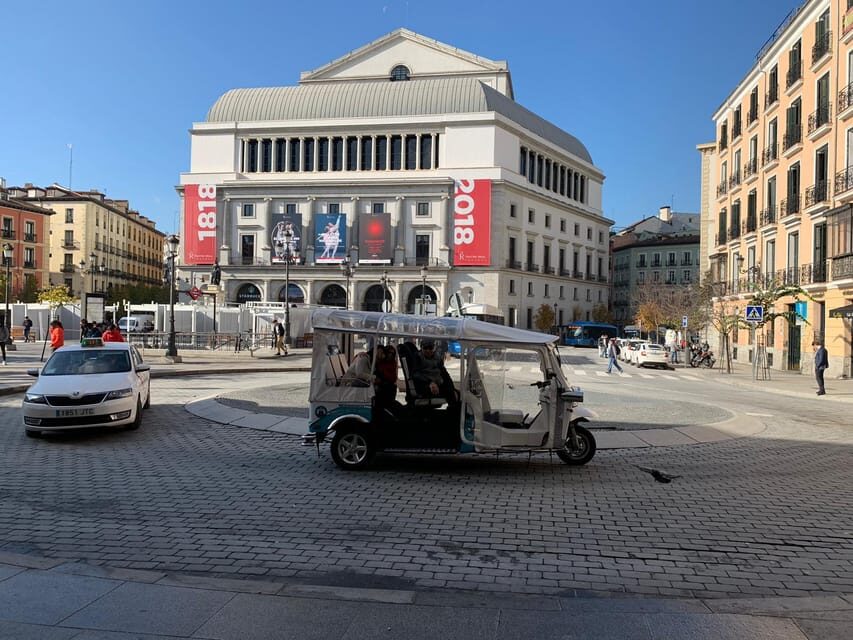
After that, you head to the Royal Palace area. The tour description notes it was home to Spain’s kings and that it is now the official royal residence. Even from outside, the palace setting signals power and ceremony. You then get a photo stop at Plaza de Oriente, a pedestrian square with gardens and statues bordering the palace.
Ópera Station and Almudena Cathedral: the ending that ties old and new together
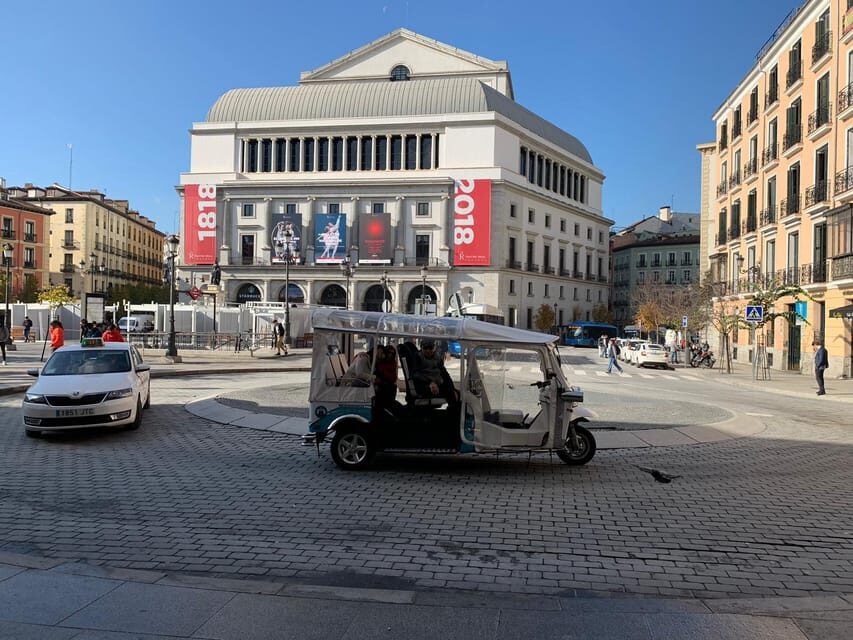
The plan includes Ópera Station, located in Plaza de Isabel II, as a key access point to Teatro Real, Plaza de Oriente, and the Royal Palace. This is practical for your future, because it tells you the transit spine of this royal zone.
Finally you reach Catedral de Almudena, Madrid’s cathedral completed in 1993 with a history over a century. The finish point feels right because it shows how Madrid kept building new religious and civic statements long after older eras ended.
The overall arc of the tour is strong: old-town street stories → food and neighborhoods → parks and gates → stadium and modern avenues → palace and cathedral. By the time you loop back toward Calle Mayor, you’ll know where you’re going tomorrow.
The one thing I’d double-check: language and audio clarity
A Madrid tuk tuk tour lives or dies on the guide’s ability to communicate. On paper, the tour offers multiple languages, including English, French, German, Italian, Portuguese, Slovenian, and Spanish. In real life, your best move is to confirm that the guide assigned to you matches the language you booked.
Audio is the other big factor. A couple booking problems describe trouble hearing the guide even at full volume. That’s not just annoying; it wipes out the reason you chose a narrated tour in the first place.
My practical advice: arrive a few minutes early so you can get a spot near the speaker area without rushing. If you are traveling with someone who needs clear instructions, choose the most comfortable seating spot possible during the ride.
Who this tour is best for (and who should skip it)
This is best for you if:
- you want a fast city orientation on your first day
- you like learning city stories while taking photos
- you prefer short stops over long museum commitments
- you are traveling with up to four people and want a shared overview by electric tuk tuk
It may not be best if:
- you expect long time inside major monuments
- you need strict language accuracy and cannot tolerate a mismatch
- you are very sensitive to audio quality, since the narration depends on the working setup during your ride
The private group element helps. You can move at a comfortable pace for your group size, and the guide can tailor the explanations more than on large buses.
Price and value: how $187 per group up to 4 can work out
At $187 per group up to 4, the math depends on who is riding with you. If you have two or four people, the cost per person drops fast compared with buying individual guide services for the same “see it all” overview.
Value comes from three things:
1) You compress a lot of major locations into 120 minutes, reducing time wasted on transit and navigation.
2) You get guide context tied to specific places, not generic narration.
3) You cover both “Madrid postcard” sites (Royal Palace, Retiro, Gran Vía) and everyday-feeling landmarks (San Miguel Market, Botín, Cava Baja).
If you are traveling solo, the price is less likely to feel like a deal unless you strongly prefer guided orientation over self-guided wandering. But if you do want that guided map and story structure, it can still be worth it.
Should you book the Madrid Tuk Tuk Welcoming Tour?
I’d book this tour if you are arriving in Madrid and want a quick, guided sense of where everything sits, from Calle Mayor to the royal and cathedral zone. The route is well chosen for a first-day overview, and it layers food spots and neighborhood stories into the same ride as big-name landmarks.
I’d hesitate only if language accuracy or hearing clarity is a must for you. Before you go, confirm your preferred language and plan to position yourself for good audio from the start. If those two things are solid, this is a fun way to get your bearings fast and set up the rest of your Madrid days.
FAQ
How much does the Madrid Tuk Tuk Welcoming Tour cost?
It costs $187 per group, up to 4 people.
How long is the tour?
The tour lasts 2 hours (120 minutes).
Where is the meeting point?
The meeting point is C. Mayor 90, Cripta de Almudena, Madrid. Look for Tuk Tuk Limo Tour branded tuktuks.
Is this a private tour?
Yes, it’s a private group (up to 4 people).
What languages are available?
The live guide is available in English, French, German, Italian, Portuguese, Slovenian, and Spanish.
Is the tour wheelchair accessible?
Yes, the tour is listed as wheelchair accessible.
What’s included in the price?
Included are the electric tuk tuk, driver/guide, insurance, and live guiding.
Does the tour include a skip-the-ticket-line benefit?
Yes, it lists a skip the ticket line benefit.
Is free cancellation available?
Yes. You can cancel up to 24 hours in advance for a full refund.
Is reserve now and pay later available?
Yes, you can reserve now & pay later, meaning you can book and pay nothing today.