REVIEW · MADRID
Tour Madrid: Royals, Plazas & Secrets 3H
Book on Viator →Operated by Green Tours · Bookable on Viator
Three hours in Madrid can feel surprisingly full. This Royals, Plazas & Secrets loop strings together big landmarks and quieter moments with quick stops, mostly free-entry sights, and a guide who keeps the pace moving.
I like how the route gives you a big-picture orientation fast, without turning your day into a checklist. I also love the flexibility I see in guides like Rommel, Daniel, Maria, and Javier, who adjust to your interests on the fly.
One thing to plan for: many stops are brief, and Royal Palace entry isn’t included, so you’ll need separate time if you want to go inside and linger.
In This Review
- Key things that make this tour click
- Why this 3-hour Royals, Plazas & Secrets ride is great for first-timers
- From Pl. de la Lealtad to Plaza de Santa Ana: a classic start with instant atmosphere
- Royal Palace area: what you see from the outside (and why that’s still worth it)
- A real planning note about tickets
- Almudena Cathedral Museum: the “small but meaningful” stop
- Debod Temple: ancient Egypt in Madrid, and how to appreciate it fast
- Plaza Mayor and Mercado de San Miguel: the old-town “heart” and a smart snack option
- Cervantes and Lope de Vega: two writer stops that add texture to the Centro streets
- Plaza de las Cortes and Neptune Fountain: when Madrid’s power shows up in stone
- Prado Museum and Jerónimos: two major free stops that can define your whole trip
- Museo Nacional del Prado
- Jerónimos (San Jerónimo el Real)
- Puerta de Alcalá, Las Ventas, and Barrio de Salamanca streets
- Puerta de Alcalá
- Las Ventas bullring
- Barrio de Salamanca
- Bernabéu and Paseo de la Castellana: modern Madrid’s identity in motion
- Plaza Colón, Biblioteca Nacional, and the big-city monuments
- Cibeles, Banco de España, and the Gran Vía-to-Retiro wind-down
- Price and value: $323.59 per group makes sense if you share it wisely
- The logistics that matter: sound, meet-up clarity, and how guides handle questions
- Should you book this Madrid tour?
- FAQ
- FAQ
- How long is the Madrid Royals, Plazas & Secrets tour?
- What’s the price for this tour?
- What language is the tour offered in?
- Is the Royal Palace ticket included?
- Are any major museum stops free during the tour?
- Where do you meet, and where does the tour end?
- Is this a private tour?
Key things that make this tour click
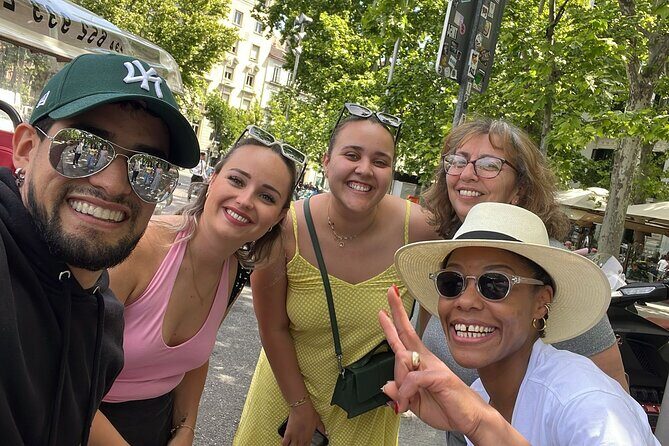
- Private group of up to 4: more control over where you pause for photos and questions.
- Mostly free sights on the route, including Prado museum, Almudena museum, and Jerónimos (ticket status is listed as free).
- A loop that makes sense geographically, moving from classic Centro to Atocha/Prado, then onward to modern Madrid.
- Guide-led Q&A energy: from Rommel to Daniel to Maria, the common theme is answering questions and tailoring the ride.
- Quick stops over long stays, ideal for orientation but not a replacement for full museum time.
Why this 3-hour Royals, Plazas & Secrets ride is great for first-timers
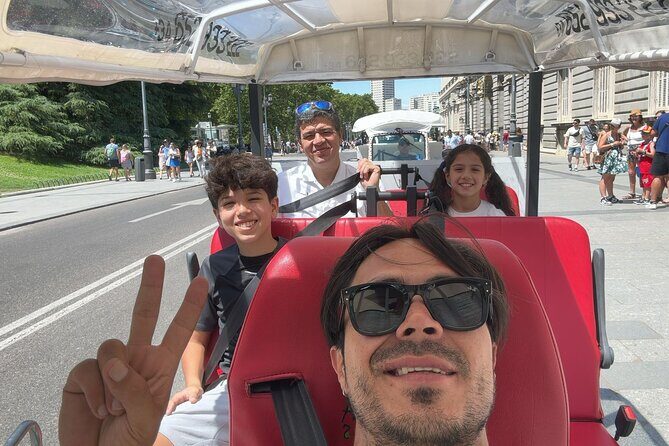
If Madrid is your first stop on a Spain trip, this is the kind of tour that helps you stop feeling lost. In about 3 hours, you get a guided circuit across the city’s most recognizable zones: Royal Madrid, old-town squares, then the modern skyline and stadium culture. It’s not trying to make you an expert on everything. It’s trying to give you the map in your head.
The format also matters. This is a private tour for your group (up to 4 people), and it’s offered in English with a mobile ticket. That combination tends to work well when you want to ask, How long should I spend here later? or What should I prioritize? The best part is how the stops are chosen: you’ll see famous exteriors, key landmarks, and a few spots that feel special even if you don’t have tickets in hand.
Now the practical bit: because the ride is short, the tour leans toward see it, understand it, photograph it, then move on. If you’re hoping for a slow museum day, you’ll likely want to book separate time for the big interiors after you’ve gotten oriented.
You can also read our reviews of more tours and experiences in Madrid


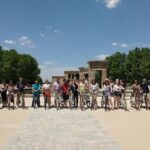
From Pl. de la Lealtad to Plaza de Santa Ana: a classic start with instant atmosphere

The tour meets at Pl. de la Lealtad, 1, Retiro, 28014 Madrid, and starts you in a part of town that’s easy to reach and well-connected. From the get-go, you’re in the zone where Madrid feels walkable, postcard-ready, and layered—old and new in one glance.
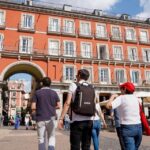
The first stop is Plaza de Santa Ana in Centro. It’s an open square dating from the early 1800s, shaped by multiple urban changes over time. Even if you only have minutes here, you get a feel for the neighborhood’s rhythm and why this area stays popular for street life.
I like starting with a plaza because it sets the tone. You’re not just “collecting sights.” You’re understanding how Madrid lives at street level before you move into royal and museum territory.
Royal Palace area: what you see from the outside (and why that’s still worth it)
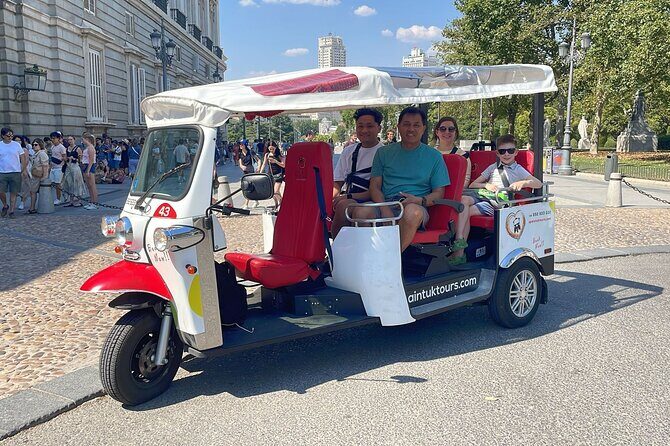
Next comes the Royal Palace of Madrid (also called Palacio de Oriente). Here’s the key context that helps: the palace is used for ceremonies and official events, while the Spanish royal residence is in Palacio de la Zarzuela. Construction began in 1738, and it took 17 years, with Carlos III establishing it as a habitual residence in 1764.
Even though this stop is short, the palace area is one of the best places in Madrid to understand scale. The building is massive, and the viewpoint matters. The tour also brings you past the Sabatini Gardens, a 2.66-hectare green space located in front of the north facade between Bailén street and the San Vicente slope. It’s a good breathing pause before you head toward museums and squares.
A real planning note about tickets
Royal Palace admission isn’t included. That’s normal for this kind of quick highlights tour. If you want to go inside and spend real time, plan a separate visit. If your goal is orientation plus great exteriors, you’ll be fine with the time you get here.
Almudena Cathedral Museum: the “small but meaningful” stop
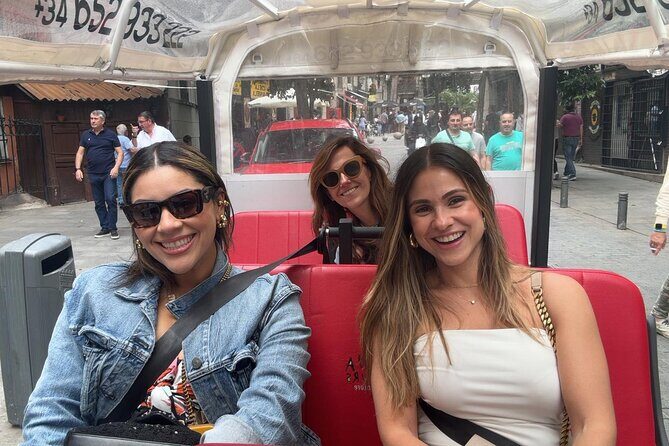
Then you’ll hit Museo de la Catedral de la Almudena. The Almudena Cathedral itself matters beyond Madrid because it was consecrated on June 15, 1993, by Pope John Paul II. The museum portion is also a smart inclusion: it gathers objects that tell the story of the diocese of Madrid across 12 rooms, ranging from mosaics to episcopal shields and more.
This stop is one of those “good use of time” moments. It’s not asking you to commit to a full-day museum plan. You get context and symbolism without getting stuck in one room forever.
You’ll also feel the tour’s logic: you’re moving from the royal “show” side (ceremonies, palace) to the religious “story” side (Almudena).



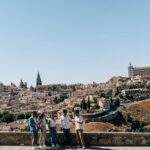
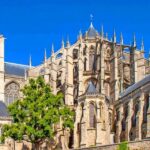

Debod Temple: ancient Egypt in Madrid, and how to appreciate it fast
From there, you’ll reach the Templo de Debod. This is an ancient Egyptian temple structure that’s been relocated to Madrid. It sits west of Plaza de España, next to Paseo del Pintor Rosales, on a hill tied to the area where the Mountain Barracks once stood.
Even with limited time, this stop can hit hard—in a good way. The contrast is the point: you’re in a modern European capital, and then suddenly you’re standing near a monument with an entirely different origin story.
If you’re the type who likes photos that look like you planned them, Debod helps. The setting gives you interesting angles that don’t look like generic tourist snaps.
Plaza Mayor and Mercado de San Miguel: the old-town “heart” and a smart snack option
Next up is Plaza Mayor, the porticoed square that’s basically the pulse of old Madrid. The tour’s description of its beginnings is useful: the Plaza Mayor site links back to the Plaza del Arrabal from the late 1400s, and when Philip II moved the court to Madrid, this market area gained importance. By 1617, Juan Gómez de Mora was commissioned to create uniform building lines, which is why the square looks so cohesive.
Plaza Mayor also hosted all kinds of major public events over the centuries—celebrations, bullfights, beatifications, coronations, and faith-related events. You don’t have to memorize that list, but it explains why the square keeps feeling like a stage.
After that, you’ll visit Mercado San Miguel, a covered market dating to around 1916. It’s known for local food, delicatessens, and events in an elegant setting. With only minutes, you’re not trying to do a full shopping spree. You’re grabbing a quick snack or drink—something that keeps your energy up for the rest of the route.
If you’re traveling with others, this is also a good place to split minor interests: one person wants seafood bites, another wants something sweet, and everyone still stays together.
Cervantes and Lope de Vega: two writer stops that add texture to the Centro streets
Then the tour leans into literature with Casa de Cervantes and Casa Museo Lope de Vega.
- Casa de Cervantes was the former residence of Miguel de Cervantes, author of Don Quijote. It offers guided tours, and the focus here is more about the meaning of the place than a deep interior visit on this short loop.
- Casa Museo Lope de Vega is tied to Lope de Vega’s life. The building dates to the 16th century, and Lope de Vega acquired it in 1610, living there until his death in 1635.
These stops can be quick, but they work because they remind you that Madrid isn’t only about palaces and museums. It’s a city of writers, ideas, and the everyday street culture that supports them.
Plaza de las Cortes and Neptune Fountain: when Madrid’s power shows up in stone
A neat mid-route pairing comes next: Plaza de las Cortes and then the Neptune Fountain.
At Plaza de las Cortes, you get a close look at Spain’s government building, built on the site of a former convent. The facade is neoclassical: a staircase leads up to a portico with six columns and a triangular pediment with reliefs. Details like the lions flanking the entrance are especially telling—they were made from the iron of cannons captured during the war in Africa. The tour also points out key interior references like the famous session room (and another room known as the lost steps).
Next: Neptune Fountain at Plaza de Cánovas del Castillo. Proposed in 1777, construction began in 1782 and finished in 1786. The fountain sits at the center of the roundabout, and it’s one of those landmarks you’ll remember later when you’re trying to find the right street.
These aren’t just “pretty things.” They help you understand Madrid’s mix of ceremonial power, public art, and everyday movement.
Prado Museum and Jerónimos: two major free stops that can define your whole trip
This is where the tour can feel like a steal in value, because you’re heading to Museo Nacional del Prado and Parish Church of San Jerónimo el Real (often called Los Jerónimos).
Museo Nacional del Prado
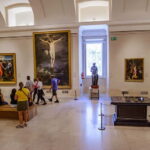
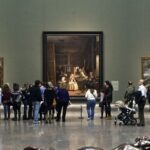
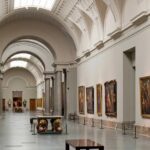
The Prado is famous for painting from the 16th to 19th centuries, with standout representation by artists like Velázquez, El Greco, Goya, Titian, and Rubens, plus major collections for El Bosco. The tour framing highlights that the museum is especially strong in European painting and includes many important works across other major artists too.
You won’t see everything in the time you have. But if you keep your expectations right—think of it as a guided orientation inside a heavyweight museum—you’ll get something lasting: the ability to walk in later and choose your own priorities with confidence.
Jerónimos (San Jerónimo el Real)
Then comes Jerónimos, a late Gothic church with Renaissance influences from the early 1500s. The connection to royalty is a core part of its story: it was ordered by the Catholic Monarchs, became a spiritual retreat for multiple monarchs, and served for royal investiture when Madrid lacked a cathedral. It also hosted the wedding of Alfonso XIII. The stairway in front, the grand approach, dates to 1906 for that wedding.
The best way to use Jerónimos on this tour is to let it reset you after Prado. Prado is art, Jerónimos is architecture and ceremony. Together, they give you two “languages” for understanding the city.
Puerta de Alcalá, Las Ventas, and Barrio de Salamanca streets
After the central classics, the tour moves into wider boulevards and modern neighborhoods.
Puerta de Alcalá
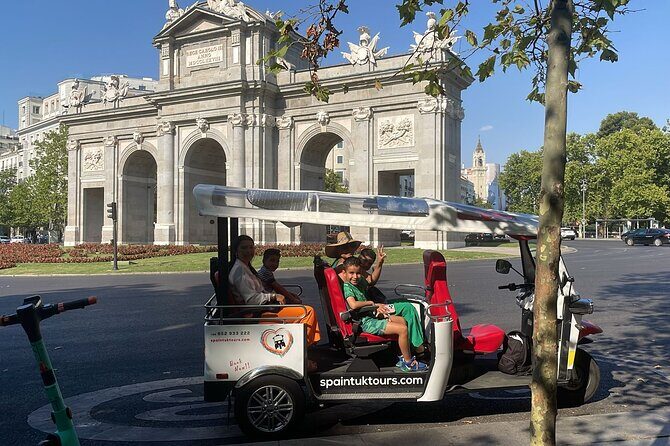
Puerta de Alcalá is a neoclassical granite triumphal arch. Carlos III commissioned it to replace an earlier gate from the 1500s, and it was inaugurated in 1778. Designed by Francesco Sabatini, it’s an important early model of this style in Europe. Unlike some similar arches, it has five openings instead of the usual three. The inner facade includes symbolic virtues: Prudence, Justice, Temperance, Fortress. The outward side has more decorative wealth and the royal shield.
If you’re into photo composition, this one is a great “you can’t miss it” stop. It’s built for framing.
Las Ventas bullring
Then it’s Las Ventas Bullring, the biggest bullfighting arena in Spain by this account, with a capacity listed as 23,798. It’s third largest in the world after those in Mexico and Valencia (Venezuela) and has a ring diameter listed as 61.5 m, second only to Valencia.
If you don’t follow bullfighting, you can still appreciate it as architecture and cultural symbol. If you do follow it, note that the tour is focused on sights, not event ticketing.
Barrio de Salamanca
Next you’ll pass through the Barrio de Salamanca, including the streets Velázquez, Ortega y Gasset, and Serrano. This part of the ride shifts your mental map: it’s where Madrid feels polished, upscale, and very “today.”
Bernabéu and Paseo de la Castellana: modern Madrid’s identity in motion
The tour reaches Santiago Bernabéu Stadium, inaugurated on December 14, 1947. Capacity is listed as 81,044. Even if you’re not a hardcore soccer fan, this is a Madrid landmark you’ll recognize instantly.
Then you’ll head along the Paseo de la Castellana, which the route describes as the financial district stretch from Salamanca toward Bernabéu. This is one of those drives that helps you understand why Madrid feels like it has multiple faces: royal stone to world-famous art to a corporate, fast-moving avenue.
Plaza Colón, Biblioteca Nacional, and the big-city monuments
Next: Plaza Colón, topped by the Columbus monument and fountain centerpiece. The white marble sculpture is described as neo-Gothic, measuring 17 meters, and built in 1885 by Jerónimo Suñol for the wedding celebration between Alfonso XII and María de las Mercedes de Orleans. There’s also the Gardens of Discovery, opened in 1970, with various sculptures. The basement hosts the Cultural Center of the Villa Fernán Gómez.
Then you’ll reach the Biblioteca Nacional de España, the National Library. The route framing is practical: it’s an autonomous body responsible for deposit, collecting, cataloging, and preserving Spain’s bibliographic and documentary heritage. It holds around 30 million publications produced since the beginning of the 18th century, including books, magazines, maps, prints, drawings, scores, and brochures.
Even if you don’t go inside, the stop adds weight to the idea that Madrid isn’t only monuments. It also protects knowledge.
Cibeles, Banco de España, and the Gran Vía-to-Retiro wind-down
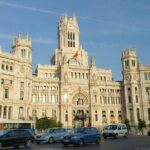
From there, Madrid turns iconic again with Cibeles Fountain at Plaza de Cibeles. The fountain represents the Roman goddess Cibeles, linked to land and agriculture and fertility, riding in a chariot pulled by two lions (connected to Hipomenes and Atalanta in myth). The route notes that Francisco Gutiérrez carved the goddess in marble, while the French sculptor Roberto Michel carved the lions. And yes, it’s also a Real Madrid fan symbol: titles and celebrations happen here.
Then comes Banco de España. From the outside, it’s decorative and important, and the description notes it was awarded at the National Exhibition of Fine Arts of 1884. The key practical detail: the interior is generally only visitable by groups from educational centers and universities, with exceptional access for some cultural or associative non-profits. So on this tour, treat it as an exterior stop that you use for architectural appreciation.
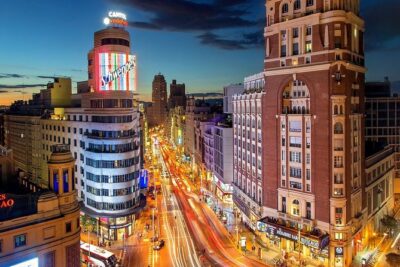
After that, you roll down Gran Vía, one of Madrid’s main streets, beginning at Alcalá and ending at Plaza de España. The tour frames it as important for commercial, tourist, and leisure life since its early 20th-century construction.
Finally, you wrap with Parque del Retiro (drive around and stop for photos near the main entrance), then ride along Paseo del Prado toward Atocha train station. You’ll also spot Teatro Real, the opera house described as about 200 years old.
This finish is a nice “sendoff” because it gets you back into the city’s flow, rather than ending in a dead zone.
Price and value: $323.59 per group makes sense if you share it wisely
The price is $323.59 per group (up to 4), for about 3 hours, with GST included. In plain terms, it becomes good value when you split the cost among friends or family.
If you’re traveling as:
- 2 people: think about roughly $162 per person
- 4 people: roughly $81 per person
That’s the sweet spot for this format, because you’re getting a private guide and a route that covers a wide geographic range in a short time. Also, many of the listed sights on the route are marked free-entry, which matters for budgeting.
The big ticket note is Palacio Real admission isn’t included. If you know you want inside access, you’ll need to plan that separately. If you don’t care as much about interiors and want the royal exterior + gardens + context, this price can feel very reasonable.
The logistics that matter: sound, meet-up clarity, and how guides handle questions
This tour runs with a mobile ticket, is offered in English, and starts and ends at the same meeting point. It’s also near public transportation, and service animals are allowed. That’s the baseline.
Now the “keep it smooth” advice. A couple of practical issues show up in past experiences: one rider reported confusion from two different meet-up instructions online, and another noted the guide didn’t have a proper PA system, so repeating questions became necessary in noisy traffic. None of that is about the route itself—it’s about execution details.
So here’s what I’d do:
- Arrive early at the exact meeting address, not five minutes after the start time.
- If you ask a question and the street noise eats it, move closer and ask again rather than assuming the guide missed it.
- Bring the mindset that this is a high-sight, short-stop tour. You’ll get more out of it when you save the deep dives for later.
Should you book this Madrid tour?
Book it if you want a fast overview of Madrid’s royal sights, major squares, and a modern-city sweep in one half-day block. It’s especially good if you like having a guide explain what you’re seeing as you go, and if you want a route that mixes famous landmarks (Prado, Jerónimos, Plaza Mayor) with “Madrid-style” street context.
Skip or rethink it if your priority is long, slow interior time—especially for the Royal Palace, where entry isn’t included. In that case, you’d likely do better adding this as a warm-up tour, then returning on another day for the places you want to linger.
FAQ
FAQ
How long is the Madrid Royals, Plazas & Secrets tour?
It’s approximately 3 hours.
What’s the price for this tour?
It costs $323.59 per group, up to 4 people.
What language is the tour offered in?
The tour is offered in English.
Is the Royal Palace ticket included?
No. The Royal Palace of Madrid (Palacio Real) admission fee is not included.
Are any major museum stops free during the tour?
Yes. The tour lists free admission for several stops, including Almudena Cathedral Museum, Prado Museum, and Jerónimos, along with multiple other sights.
Where do you meet, and where does the tour end?
The tour starts at Pl. de la Lealtad, 1, Retiro, 28014 Madrid, Spain, and ends back at the same meeting point.
Is this a private tour?
Yes. It’s described as a private tour/activity, with only your group participating (up to 4 people).