REVIEW · MADRID
Madrid Scavenger Hunt and Sights Self-Guided Tour
Book on Viator →Operated by Explorial · Bookable on Viator
Madrid is better as a game.
This self-guided hunt turns the usual sightseeing loop into a points-based mission you complete at your own pace. You’ll walk between major sights, use an in-app map to get around, then solve tasks that are tied to what you’re actually seeing—signs, pictures, and other on-site details. The payoff is simple: you leave with Madrid facts in your head, not just photos on your phone.
What I really like is the way it mixes question-solving with creative challenges. One part feels like a pop quiz you can enjoy, and another part asks you to do photo tasks that reward good thinking (and yes, a little playful stubbornness). The second big win: it’s designed for flexibility—there’s no hard time limit, so you can slow down, take breaks, and keep going when the city day gets warm.
The only drawback to consider is that it’s not a guided narration. You’re steering your own experience through an app, so if you want a live person telling stories step-by-step, this won’t feel like that. Still, the structure is clear and the sights are strong for a short outing.
In This Review
- Key highlights at a glance
- A Self-Guided Madrid Game That Still Feels Like Real Sightseeing
- Starting at C. Alcalá 48 and Getting Into the Explorial-App
- Stop 1: Palacio de Cibeles and Why It Sets the Tone Fast
- Stop 2: Puerta de Alcalá for Classic Madrid Photos and Quick Logic
- Stop 3: Parque del Retiro for Break Time and Better Recall
- Stop 4: Palacio de Cristal and Turning Creativity Into Points
- How the Tasks Actually Teach Madrid (Without Turning It Into School)
- Duration, Pacing, and What a Realistic Day Looks Like
- Price and Value: Why $10.56 Can Feel Like a Win
- Who This Madrid Scavenger Hunt Is Best For
- Quick Practical Tips Before You Start
- Should You Book This Madrid Scavenger Hunt?
Key highlights at a glance
- App-led navigation that uses a map to guide you between stops at your own pace
- Point system for completing sight-finding tasks, quizzes, and photo challenges
- On-site answers you’re meant to notice in signs, pictures, and details at each location
- Built-in learning through a mix of knowledge, question prompts, and number-style tasks
- A classic Madrid route featuring Palacio de Cibeles, Puerta de Alcalá, Parque del Retiro, and Palacio de Cristal
- English experience delivered through the Explorial-App with an access code after booking
A Self-Guided Madrid Game That Still Feels Like Real Sightseeing

This isn’t a museum-style audio tour. It’s more like a city adventure you can play while sightseeing—without needing to schedule anything beyond getting to the starting point. The heart of it is that you’re always doing something: finding a location using hints, reading and observing your surroundings, then answering questions that connect to the place you’ve reached.
I like how that design changes how you move through the city. Instead of just walking from one famous spot to the next, you’re scanning. You notice details because the game asks you to. That’s how you learn without feeling like you’re studying.
And because it’s self-guided, you control the pace. The experience typically runs about 1–2 hours on average, but it’s not limited in time. If you want to take a longer look at something, you can. If you want to pause for a drink or just sit for a minute, you can.
You can also read our reviews of more guided tours in Madrid



Starting at C. Alcalá 48 and Getting Into the Explorial-App

Your start is straightforward: C. Alcalá, 48, Centro, 28014 Madrid, Spain. The tour ends back at the same meeting point, so you don’t have to worry about solving a complicated end-location problem.
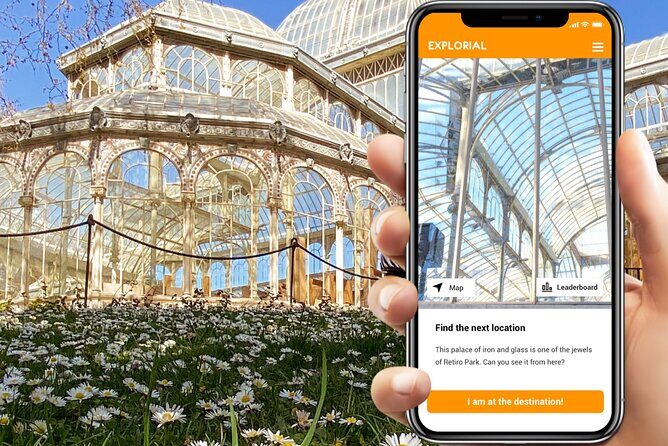
After you book, you get an access code that you’ll use in the Explorial-App. From there, you’re set. The app includes a map function to help you reach each stop, and it’s what keeps the hunt flowing. You won’t be left wondering what to do next—your next task is always tied to where you are and what you need to find.
One practical advantage: the meeting area is near public transportation, so you can fit this into a bigger day in Madrid. If you’re staying central (or just passing through), it’s easy to slot in as a half-morning, a late lunch break plan, or an afternoon activity.
Also, it’s English. That matters because the questions and guidance are delivered in that language through the app.
Stop 1: Palacio de Cibeles and Why It Sets the Tone Fast

The hunt starts with Palacio de Cibeles. This is a smart first stop because it’s a major landmark area that helps you orient quickly. You’ll arrive, follow hints, then shift into the game mode: look closely and answer questions connected to what you see.
What you can expect here is a mix of observation and short problem-solving. Often, the answers are hidden in signs, pictures, or on-site details, so you’re not just sightseeing—you’re hunting for specific information. The payoff is that you start learning immediately, instead of saving the learning for later.
A small caution: because the experience is interactive, you’ll want to keep your eyes on your surroundings, not just on the landmark name. If you rush straight to photos, you may miss the clue-like details the questions depend on.
Stop 2: Puerta de Alcalá for Classic Madrid Photos and Quick Logic
Next comes Puerta de Alcala. This is one of those sights that people recognize instantly, and it’s a great match for the hunt format. You get to enjoy the iconic look, but you also have a reason to slow down and study.
Here’s how the game usually feels at a stop like this: the app prompts you, you find the correct viewpoint or detail, then you answer a question that’s designed to push you to look where you might not look on a normal sightseeing walk. This is where the scavenger-hunt approach really shines, because it makes a famous monument feel more personal.
You’ll also see the game’s creative side during the route. The format includes photo tasks, and you’ll earn points for doing well. Sometimes the photos are less about taking the perfect image and more about composing the scene in a way that matches the prompt—basically, creativity with rules.
Stop 3: Parque del Retiro for Break Time and Better Recall

Then you move into Parque del Retiro, one of Madrid’s most beloved green spaces. For this part of the hunt, the experience becomes more flexible and more comfortable. Parks are ideal for breaks, and you can take your time because the tour isn’t locked to a strict schedule.
This is where I think the experience can be extra enjoyable if you’re traveling with someone. The tasks make it easy to share a laugh while you point out clues, then compare answers. One review described the mix of tasks as a good blend of knowledge and photo work, and the structure fits a place like Retiro well.
Also, the nature of the tasks helps with memory. When questions are answered by looking at signs, pictures, or details, you don’t just pass by. You register what you’re seeing. Later, you’ll likely remember not only that you visited Retiro, but also the specific detail the hunt asked you to notice.
If it’s hot, this stop works because you’re in an outdoor area where pausing is normal. Plan to use that freedom. Sitting for a bit doesn’t break the game. It’s part of playing smart in the city.
You can also read our reviews of more tours and experiences in Madrid






Stop 4: Palacio de Cristal and Turning Creativity Into Points
The final sight listed is Palacio de Cristal. This stop is where the hunt’s photo element can feel especially fun. A place like this has visual shapes, reflections, and angles that are naturally photo-friendly, which makes creative photo prompts easier to pull off.
You’ll likely face tasks that reward your effort with points, so the goal becomes less about rushing and more about experimenting. The game explicitly includes photo tasks that require creativity, and doing them well is the way to rack up points.
The other thing this stop offers is emotional payoff. After you’ve solved questions in earlier locations, this final leg feels like the moment where you can celebrate with your photos and wrap things up without feeling done too early.
If you’re the type who normally takes ten nearly identical photos, this is a good prompt to break that habit. Try to match the photo instruction in a way that’s actually different from your usual style. The hunt format nudges you to do that.
How the Tasks Actually Teach Madrid (Without Turning It Into School)
The best part of this kind of self-guided format is that it turns passive seeing into active noticing. Your main job throughout the route is to do three things:
- Find sights with hints, using the app’s map to stay on track
- Solve questions on-site, where answers are hidden in signs, pictures, and details
- Complete photo tasks, designed to test creativity and earn points
You’ll also see a mix of challenge types. Some math-style thinking is part of the fun for this hunt, along with knowledge tasks and photo work. That blend matters because it prevents the experience from becoming repetitive. One moment you’re reading and observing. The next moment you’re figuring something out. Then you’re switching to creativity.
And the question design means you’re learning by doing. Instead of memorizing names, you’re connecting names to visible details. That’s the difference between forgetting a fact the next day and remembering it on your next walk.
Duration, Pacing, and What a Realistic Day Looks Like

The experience is listed as about 2 hours, and it averages 1–2 hours for most play. But the big advantage is that there’s no time limit, so you don’t feel the pressure to sprint.
For planning, think of it like this: you can treat it as a compact loop that gives you several major sights without needing a big tour day. You’ll walk between stops on foot, and you’ll spend time answering prompts at each location.
In practice, that means you can fit it into a day when you want to see highlights but also want space for your own rhythm. It’s also a nice option when you don’t want to commit to a fixed group schedule.
Price and Value: Why $10.56 Can Feel Like a Win
At $10.56 per person, the price is low enough that you should judge it by value, not by whether it feels like a premium guided tour. Here’s what you’re really paying for:
- Access to the Explorial-App and the game content
- A structured route through several major Madrid sights
- A blend of knowledge tasks and photo challenges
- A self-guided format that lets you pause and move at your own pace
For many people, the value is the “doing” part. You’re not just spending money to enter one place. You’re spending it to turn a walk into a game that helps you learn. And because it’s designed around multiple stops—Palacio de Cibeles, Puerta de Alcala, Parque del Retiro, Palacio de Cristal—you get more than a one-point highlight.
If you like interactive activities, short walking routes, and learning on the move, the cost starts to make sense fast.
Who This Madrid Scavenger Hunt Is Best For
This works especially well if you:
- Want to explore at your own pace rather than following a group on rails
- Enjoy puzzle-like tasks and getting answers through observation
- Like pairing sightseeing with a fun challenge, especially photo prompts
- Are traveling as a couple or small private group and want an activity that feels shared
It’s also a private tour/activity, meaning only your group plays. That’s a plus if you dislike the pressure of keeping up or being distracted by strangers.
Accessibility notes are limited in the info you have, but it does say that most travelers can participate, service animals are allowed, and the start point is near public transportation. If you have specific mobility needs, it’s smart to plan for walking between the main stops and the time spent at each location.
Quick Practical Tips Before You Start
These are the kinds of habits that make the game smoother:
- Give yourself a little buffer time at each stop. The best scores come from not rushing.
- Be ready to use your phone camera for photo tasks.
- Look for the clue-like details the questions depend on, not just the big landmark views.
- If you’re visiting on a warm day, plan to use the natural pause points in Retiro.
Also, double-check that you’re playing in English so the question prompts and instructions match what you expect.
Should You Book This Madrid Scavenger Hunt?
Yes, I’d book it if you want a short Madrid plan that’s fun, structured, and easy to run on your own. The route hits major sights—Cibeles, Puerta de Alcalá, Retiro, and Cristal—while the game format helps you learn what you’re looking at. With a low price and flexible timing, it’s a good way to turn a simple walk into something memorable.
Skip it if you want a live guide or a deep lecture style tour. This experience is about your own pace and your own detective work through the app.
If you want Madrid to feel like a story you solved with your own eyes, this scavenger hunt is a smart pick.