REVIEW · MADRID
Tour Madrid in 2 hours! Electric Tuk – Fast, Fun, and Exclusive
Book on Viator →Operated by Green Tours · Bookable on Viator
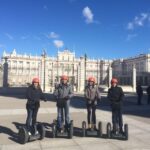
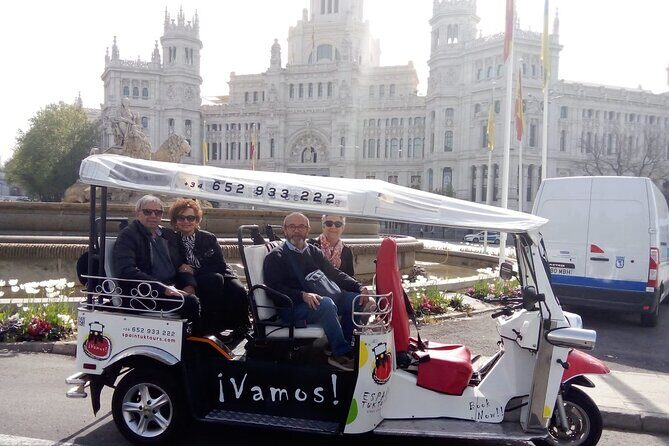
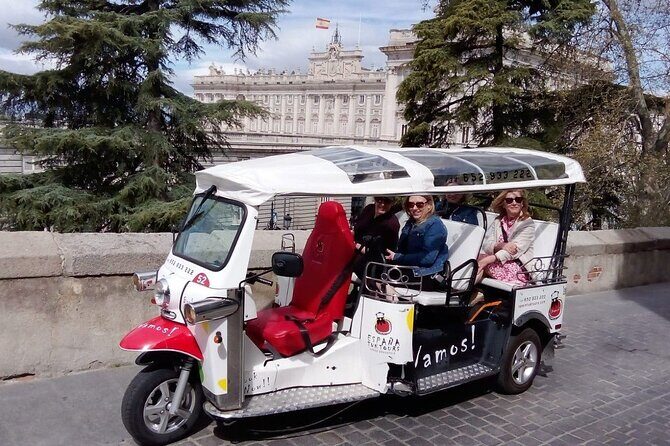
Two hours, a lot of Madrid. This private electric tuk ride is built for getting your bearings fast, without the stress of trains, buses, or figuring out routes. You’ll zip past major landmarks, with short stops that let you hop out for photos and quick looks, then roll on to the next spot.
I like that the tour stays efficient. In a short window you cover old-town icons like Plaza Mayor and Mercado San Miguel, plus big-neon Madrid stops like Las Ventas and the Santiago Bernabéu area. I also like that it’s small and private: up to 4 people per group, with an English option and a mobile ticket.
One thing to plan for: with so many famous stops packed into about 2 hours, this is not a slow museum day. Expect quick photo stops and mostly exterior viewing, and note that the Royal Palace entry isn’t included.
In This Review
- Key highlights worth clocking
- How this 2-hour electric tuk tour actually works
- Royal and religious Madrid in one sweep: Plaza de Santa Ana to Jardines de Sabatini
- A fast tour through Debod, Plaza Mayor, and Mercado San Miguel
- Literary Madrid and a big church moment: San Francisco el Grande, Cervantes, and Lope de Vega
- Plaza de las Cortes, Neptune Fountain, and Puerta de Alcalá: classic facades with hidden clues
- Art-meets-prayers: a major European painting museum area and Los Jerónimos
- Las Ventas, Salamanca, Bernabéu: Madrid after the central core
- Colón, BNE, Cibeles, and the Bank of Spain: monuments with real civic power
- Gran Vía and the value of a “get oriented” day
- My take: when to book, and when to skip
- FAQ
- Is this tour private?
- How long is the tour?
- Where does the tour start and end?
- What language is the tour offered in?
- Is admission included for the Royal Palace of Madrid?
- Can I cancel for a refund?
Key highlights worth clocking
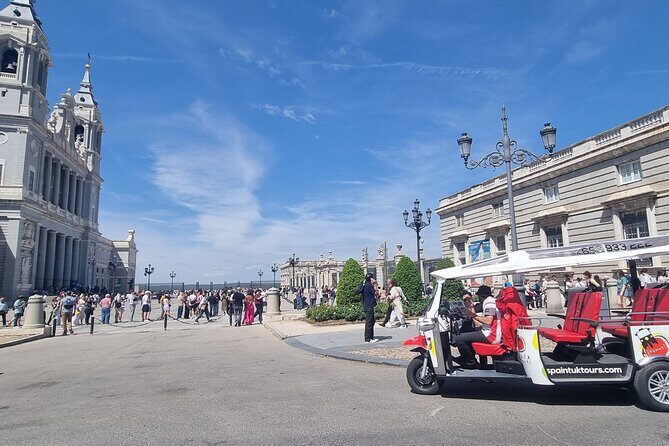
- Electric tuk convenience: less walking, more seeing, especially on a first day.
- A guide who talks details: from palace-era context to why certain facades look the way they do.
- Photo-friendly pacing: quick moments at big backdrops, plus help getting good angles.
- Old Madrid to modern Madrid: plazas and churches, then neighborhoods like Salamanca and Paseo de la Castellana.
- On-route classics: Royal Palace grounds, Plaza Mayor, Mercado San Miguel, Puerta de Alcalá, Cibeles Fountain.
- Small-group feel: it’s private, so you’re not stuck with a huge crowd pace.
How this 2-hour electric tuk tour actually works
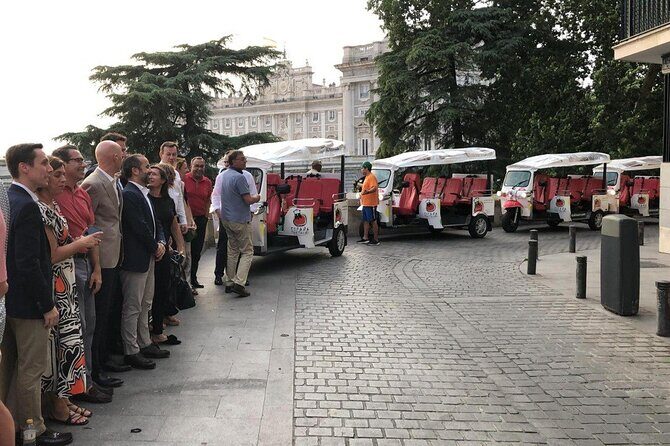
You meet at Pl. de la Lealtad, 1 in Retiro, and the experience ends back at the same spot. It’s a private tour for your group only (up to 4 people), and you get a mobile ticket. The tour is offered in English, and confirmation comes at the time you book.
The big idea here is speed with story. You’re not meant to “see everything.” Instead, you get a well-chosen sweep of Madrid’s most recognizable sights, with enough context to help you later decide what deserves a return visit (and what doesn’t).
The time pressure matters. Some stops are listed around 5–10 minutes. That’s plenty for a photo and a quick orientation. It’s not enough for long lines, museum wandering, or deep reading in historic sites—so think of this as your “map in motion.”
You can also read our reviews of more tours and experiences in Madrid

Royal and religious Madrid in one sweep: Plaza de Santa Ana to Jardines de Sabatini
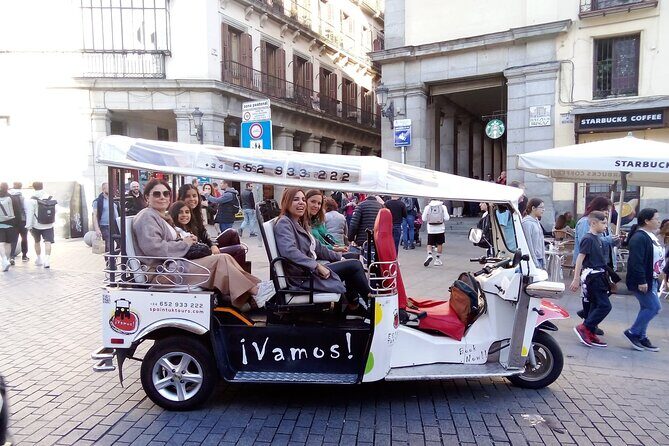
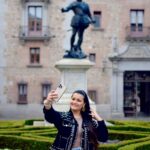
You start in the Centro area at Plaza de Santa Ana, an open square in the Cortes neighborhood dating back to 1810. Even if you’ve seen Madrid postcards, this plaza helps you feel the city’s street-level rhythm—an easy place to settle your eyes before the monuments start.
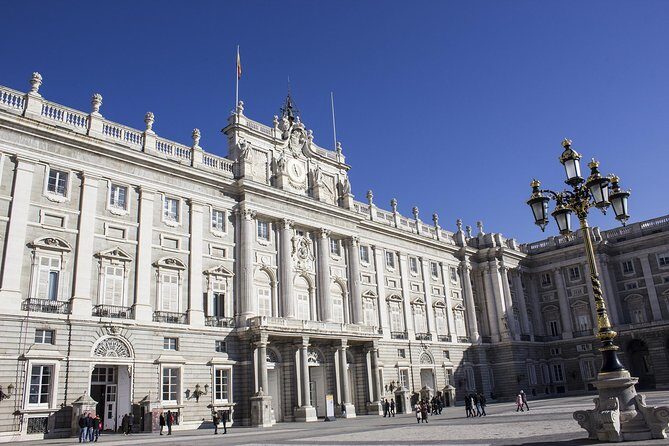
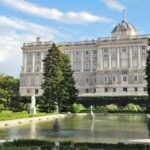
Next is the Royal Palace of Madrid (Palacio de Oriente). The tour frames it as a working royal building now used for receptions and ceremonies, since the Spanish royal residence is at Palacio de la Zarzuela. Construction began in 1738 and lasted about 17 years, and the site ties back to an earlier palace (the Palace of the Austrias) that was destroyed by fire on Christmas Eve in 1734. You’ll likely get exterior viewing and quick orientation time here, but Palacio Real admission isn’t included, so treat it like a “see it from close by” stop, not a full interior visit.
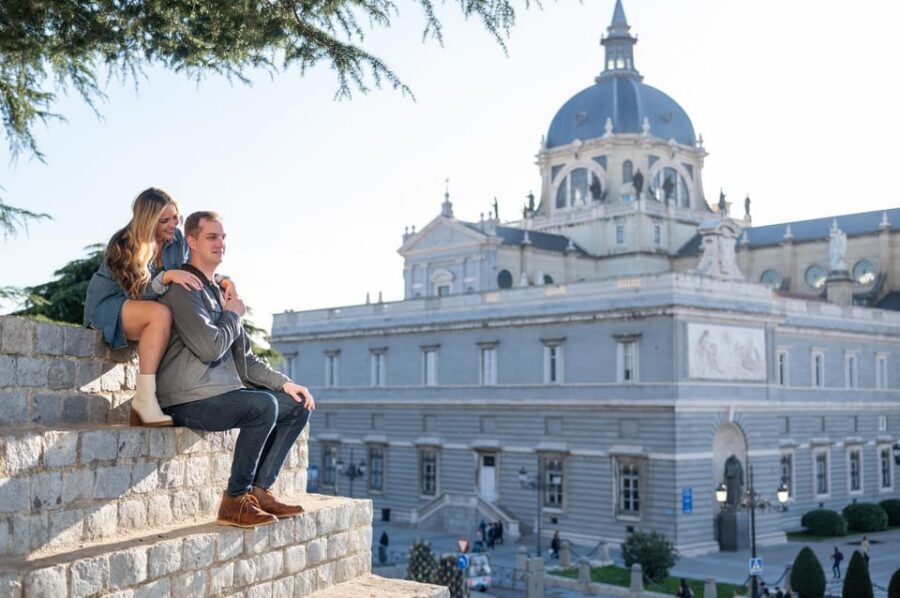
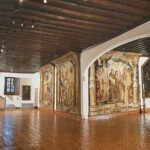
From there, you head to the Museo de la Catedral de la Almudena. The Almudena Cathedral is the main religious building in Madrid, and the museum collects artifacts that tell the diocese story across multiple rooms. The format matters: the museum is organized into twelve rooms featuring objects ranging from mosaics to episcopal shields and decorative pieces. It’s a great match for a short stop because it’s structured and focused.
Then comes Jardines de Sabatini, the gardens in front of the north facade of the Royal Palace. They cover about 2.66 hectares, and the location gives you a clean visual reset: you’re still right by palace territory, but now you can breathe, look for symmetry in the grounds, and grab photos without the palace crowds.
A fast tour through Debod, Plaza Mayor, and Mercado San Miguel
Next, the route includes the Temple of Debod. This is a real “how did this end up here” Madrid stop: an ancient Egyptian building placed in the Spanish city. It sits west of Plaza de España, by the Paseo del Pintor Rosales, and it’s on a hill where the Mountain Barracks used to be. Even if you only get a short moment, it’s one of those stops that changes how you think about Madrid’s connections to the wider world.
Then you move into Plaza Mayor, the heart of Old Madrid (Madrid de los Austrias). This square started life on the site of the old Plaza del Arrabal, which hosted Madrid’s popular market at the end of the 15th century. When Philip II moved the court to Madrid, the square took on more importance, and in 1617 architect Juan Gómez de Mora was commissioned to create uniform building lines. Historically, it hosted everything from public celebrations to bullfights and religious events, which is why it still feels like a stage.
If you want a sensory pause, Mercado San Miguel is the practical choice. It’s a covered market from around 1916, known for local foods and delicatessen-style browsing in an elegant atmosphere. The tour won’t turn this into a full meal. Instead, it’s a chance to see the market’s vibe and decide if you want to come back for snacks later.
Literary Madrid and a big church moment: San Francisco el Grande, Cervantes, and Lope de Vega
You also pass by major “literature + faith” touchpoints.
First, there’s the Royal Basilica of San Francisco el Grande (officially Basilica of Our Lady of the Angels). It’s a Catholic church in Madrid in the Palacio neighborhood, sitting in the historic center. Even with minimal stop time, this is one of those landmarks that helps you understand why Madrid isn’t only about royal power and museums—it’s also about citywide religious presence.
Then the route includes the former residence of Miguel de Cervantes, author of Don Quijote. You’ll find it with guided tours listed as part of the site’s identity. Right nearby on Cervantes Street is also the House of Lope de Vega. It was built in the 16th century, and Lope de Vega acquired it in 1610, living there until his death in 1635.
Here’s the practical angle: in a 2-hour tuk tour, you should expect these to be “you are here” moments. If you want the full interior story for either writer’s house, plan a separate visit later. The tuk ride helps you place them on the mental map so you know where to return.
Plaza de las Cortes, Neptune Fountain, and Puerta de Alcalá: classic facades with hidden clues
Plaza de las Cortes is a strong contrast stop because it’s political Madrid without feeling like bureaucracy. The Palace of the Spanish Courts was built on the site of the former convent of the Holy Spirit, used as the seat of Congress between 1834 and 1841. The facade is neoclassical with a staircase leading to a portico supported by six Corinthian columns. Above, the triangular pediment carries reliefs by Ponciano Ponzano.
Look closer and the details get fun: the entrance lions are sculpted by the same artist and were cast using iron from cannons captured during the war in Africa. The bronze door under the pediment opens only on very marked occasions—so don’t expect access. But you can still appreciate the sculpture choices and the symbolism.
Then you get Neptune Fountain in Plaza de Cánovas del Castillo. It’s a neoclassical fountain in the center of the roundabout that shares its name. Construction details matter here too: proposed in 1777, begun in 1782, and completed in 1786. Even in a quick stop, that timeline helps you read the city’s architectural rhythm.
Finally, Puerta de Alcalá is a must-see for architecture fans. Built on Carlos III’s order to replace an earlier 16th-century gate, it was inaugurated in 1778. Designed by Francesco Sabatini, it’s a granite neoclassical arc of triumph. It’s also notable for having five openings instead of the usual three. The decorations differ between facades—the city-facing side is easier to spot first, while the outer face has more decorative wealth, because that’s what visitors entering Madrid would have seen.
This cluster of stops is where a tuk tour earns its keep: big exteriors, quick context, and photos that actually make sense afterward.




Art-meets-prayers: a major European painting museum area and Los Jerónimos
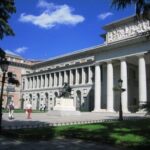
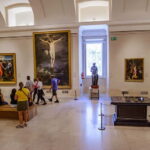
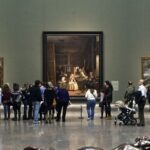
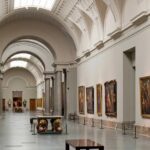
The route also heads into the Prado-area orbit, tied to one of Europe’s best-known painting collections. The highlight is the museum’s strong representation of masters from the 16th to the 19th centuries, with major presence of Velázquez, El Greco, Goya, Tiziano, Rubens, and El Bosco. It’s also singled out for having the best and most extensive collections of Bosch’s work in the world. If you’re an art person, this is the moment that tells you why Madrid is a serious destination, not just a weekend stop.
Right after, you’ll reach Los Jerónimos, the Parish Church of San Jerónimo el Real. The church is late Gothic with Renaissance influences from the early 16th century. Its royal connection is part of the story: built by order of the Catholic Monarchs, it became a spiritual retreat for several monarchs. It also served royal investitures for centuries when there wasn’t a cathedral, and it hosted the wedding of Alfonso XIII.
One practical detail: the great stairway leading to the entrance was built in 1906 for that wedding. So when you spot the steps, you’re looking at a specific historical choice—not just a random decorative feature.
Las Ventas, Salamanca, Bernabéu: Madrid after the central core
Now the tour turns toward “sports + style + street life.”
Las Ventas bullring is one of Spain’s biggest bullfighting venues. The key numbers are impressive: it seats 23,798 spectators, and it’s the third largest bullring in the world by this kind of capacity reference (after Mexico and Valencia). The ring diameter is listed at 61.5 meters. Even if you’re not into bullfighting, this is a powerful architectural landmark and a reminder that tradition in Madrid has scale.
Next is Barrio de Salamanca, with main streets you’ll recognize if you’ve seen Madrid shopping maps: Velázquez, Ortega y Gasset, and Serrano. It’s where Madrid shifts from historic core density into an elegant, more modern feel.
Then you reach Santiago Bernabéu Stadium. It opened on December 14, 1947, and its current capacity is listed at 81,044 spectators. If you’re a football fan, this is the “standing near it” moment that helps your brain link the TV with the real city.
Finally, the route runs along the Paseo de la Castellana in the financial district. The whole point is contrast: you see how quickly the city goes from classic plazas and churches to a major urban corridor.
Colón, BNE, Cibeles, and the Bank of Spain: monuments with real civic power
Plaza de Colón brings a different Madrid mood. It’s anchored by a Christopher Columbus monument in neo-Gothic style built in 1885 by Jerónimo Suñol for the wedding celebration between Alfonso XII and María de las Mercedes de Orleans. The monument is 17 meters tall. The square also includes the Gardens of Discovery, opened in 1970, with sculptures around the area.
You also pass the National Library of Spain (BNE). The mission is what makes it interesting: it’s responsible for collecting, cataloging, and conserving Spain’s bibliographic and documentary heritage, with custody of around thirty million publications produced in national territory since the beginning of the 18th century. The types included—books, magazines, maps, prints, drawings, scores, and brochures—give you a sense of the scale.
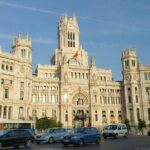
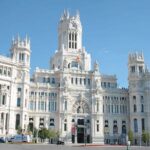
Then comes Cibeles Fountain. It’s surrounded by major buildings: Palacio de Buenavista, Palacio de Linares, Palacio de Comunicaciones (the City Council), and the Bank of Spain. The fountain represents the Roman goddess Cibeles, tied to land and fertility, with a car pulled by two lions. There’s a myth angle and a craft angle too: the goddess and lions are carved in marble and the rest in stone. The key cultural tie is football—Cibeles is an icon for Real Madrid fans because team titles are celebrated there.
The tour also includes the Banco de España building. Here’s the useful heads-up: the interior can’t be visited routinely, only by groups from educational centers and universities, and exceptionally by non-profit cultural and associative entities. So again, think exterior viewing here unless you have the right invitation.
Gran Vía and the value of a “get oriented” day
The route finishes with the Gran Vía area. Gran Vía is one of Madrid’s main streets, running from Calle de Alcalá to Plaza de España. It’s a major marker from the early 20th century, and it plays a big role in commercial, tourist, and leisure life. Seeing it from the tuk gives you a sense of scale—Madrid can feel concentrated, but Gran Vía shows the city’s long, straight energy.
If you only have one day, this tour helps you avoid the classic mistake: spending hours zig-zagging across Madrid with no plan. Instead, you come out with a mental checklist: palace territory, Old Madrid, the big gate, the football stadium zone, and the civic monument belt around Cibeles and Colón.
My take: when to book, and when to skip
Book this if you want a smart first-day overview and you like the idea of moving quickly between neighborhoods. It’s also a good call if your group ranges in interests—someone can love plazas and architecture while another person gets excited about Las Ventas and Bernabéu. The private format makes it feel less like a bus tour and more like you’re getting a guided orientation.
Skip it if your goal is interior access and long museum time. The Royal Palace isn’t included, and several stops are too short to plan for deep visits. You’ll still learn a lot from the facades and context, but this won’t replace a dedicated day at major museums or historic house sites.
Also, keep your expectations practical. Based on what I see highlighted around guides and drivers, the best experiences tend to come when you’re flexible about timing and you’re ready for short stops. If you care a lot about language, double-check the setup when you book so you’re not surprised on the day. If there’s confusion with meeting points, the team has shown they’ll try to get you connected quickly—one clear example is when staff helped travelers find the right location and handled a friendly reset while waiting.
In short: if you want to get your bearings fast and see Madrid’s biggest “wow” sights in motion, this electric tuk tour is a strong bet.
FAQ
Is this tour private?
Yes. It’s listed as a private tour/activity, with only your group participating. Group size is up to 4.
How long is the tour?
The duration is about 2 hours.
Where does the tour start and end?
It starts at Pl. de la Lealtad, 1, Retiro, 28014 Madrid, Spain and ends back at the meeting point.
What language is the tour offered in?
The tour is offered in English.
Is admission included for the Royal Palace of Madrid?
No. Admission fee for Palacio Real is not included.
Can I cancel for a refund?
Yes, you can cancel for a full refund if you cancel up to 24 hours in advance. If you cancel less than 24 hours before the start time, you don’t get a refund.