REVIEW · MADRID
Spanish Group Course in Madrid, Spain: 20 Lessons
Book on Viator →Operated by Expanish · Bookable on Viator
Learning Spanish in Madrid, done the practical way.
This Spanish group course is built for real conversation fast, not just worksheets. You’re in a small group with interactive classes, and the format is designed to keep you speaking Spanish while still getting the kind of guidance that helps you correct mistakes quickly. I like that it’s capped at 12 students, so the professor can actually notice what you’re getting wrong (and fix it) instead of letting you disappear in the back row.
Two things I really like: the 20 lessons across about 5 days means steady progress without feeling like an endless grind, and the included welcome pack + first-day orientation helps you get organized from day one. One consideration: class and group arrangements can vary, and one person reported getting placed at a level that felt too easy at first; they also mentioned classroom size feeling tight for beginners. So if your starting level is important to you, plan to ask how placement works and what happens if the group level doesn’t fit.
In This Review
- Key things to know before you go
- Spanish classes in Madrid, with real speaking time
- Price and value: why $275 can be a smart deal
- Your daily rhythm starts at 9:30 (and ends back at the meeting point)
- What you actually do across 20 lessons
- Teachers who guide you (and keep it friendly)
- Social activities: practice Spanish with people, not just textbooks
- Group size, room comfort, and level matching: what to watch
- Where this course fits best (and who it might not)
- Should you book Spanish Group Course in Madrid (20 lessons)?
- FAQ
- How many lessons are included in the Spanish course?
- How long is the experience in total?
- Where is the meeting point and what time does the course start?
- What languages is the course offered in?
- What’s included in the price of $275?
- What is not included?
- How does cancellation work?
Key things to know before you go
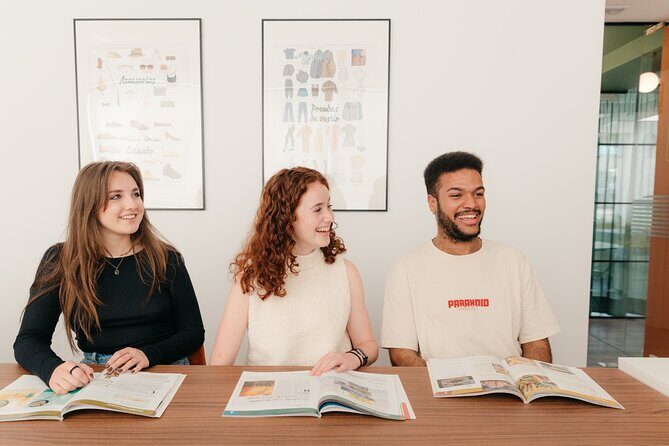
- Small group size (max 12): more speaking time and easier feedback from the teacher
- 20 lessons in about 5 days: a clear push forward without dragging on for weeks
- English is supported: helpful if you’re starting from scratch or need quick clarification
- First-day orientation: you’ll get the rules of the class and how the week runs
- Included social activities: chances to use Spanish with other students, not just in class
- Certificate + welcome pack: neat little finish-line items to mark your effort
Spanish classes in Madrid, with real speaking time
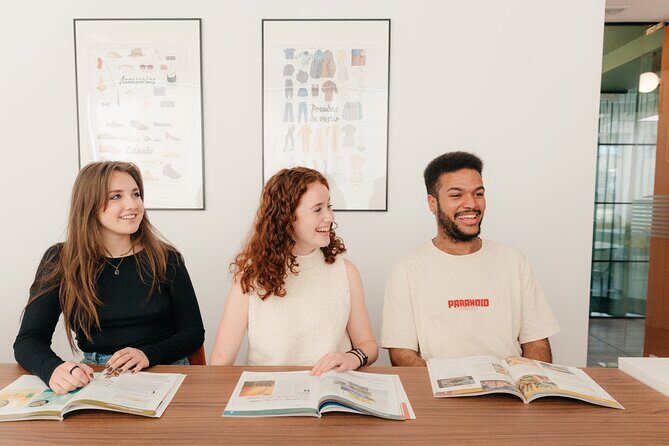
Madrid has a way of making languages feel doable. Even if your Spanish starts out basic, the city keeps offering you chances to practice in shops, cafes, and on the street. This course leans into that momentum by using group interaction as the main engine of learning.
The “interactive group” setup matters. In a bigger class, you can hide behind listening. In a smaller one, you can’t. You’re pushed to answer, repeat, and re-formulate what you’re trying to say. And that’s where progress usually comes from—getting your mouth to work, not just your eyes.
The course is offered in English, which I see as a practical advantage. If you’re nervous, having an English-speaking instructor and support can help you understand grammar explanations, rules, or class expectations without slowing down your Spanish practice. You don’t have to rely on guessing what the teacher means.
You can also read our reviews of more tours and experiences in Madrid



Price and value: why $275 can be a smart deal
At $275 per person for about 5 days and 20 lessons, the value is mostly about time efficiency. You’re buying focused contact with a teacher plus a structured push to use Spanish every day. That’s usually more useful than trying to “self-study” on your own while also sightseeing.
Here’s the trade-off: the price includes course support and social elements, but it doesn’t include food and drinks or a course book. So you’ll need to budget for meals and any learning materials you’re expected to use. Still, the structure is clear, and you’re not paying extra for the essentials that help classes run smoothly (like orientation and Wi‑Fi access).
The included course certificate is also worth noting. It won’t magically make you fluent, but it gives you something concrete for your resume or personal records—especially if you’re learning for work, school, or a future trip.
Your daily rhythm starts at 9:30 (and ends back at the meeting point)

The course starts at 9:30 am at Calle de Castelló, 23, Salamanca, 28001 Madrid. That timing is useful if you’re the type who likes mornings. You’ll be learning early, then you can use the rest of the day to practice what you just studied.
The meeting point location is in Salamanca, and it’s also listed as near public transportation. That’s a real quality-of-life detail. You don’t want to spend your limited study days fighting transit, especially when classes are only about five days long.
The course ends back at the meeting point. That means you can plan your afternoons without worrying about complicated pickup logistics.
What you actually do across 20 lessons
You don’t get a long list of sight-seeing stops here. Instead, the “itinerary” is really your learning week: lessons, orientation, and social activities built around speaking.
Here’s what your days are likely to feel like:
Day 1: Orientation + getting placed and started.
You’ll have a first-day orientation included. In practice, that usually means rules, expectations, and how the week will flow. It’s also the moment where level organization happens, and one piece of feedback you should keep in mind is that placement can feel off for some students at the beginning.
Days 2–4: Repeated practice with interactive group work.
With 20 lessons total, the schedule is designed to keep you using Spanish again and again. This is where group learning is most effective: you’ll hear Spanish from other students, respond, and correct course in real time.
Day 5: Wrap-up and certificate.
The course includes a certificate, so the ending isn’t just “that’s it, goodbye.” There’s a finish line that makes the learning feel complete.
Because specifics of lesson topics and daily schedule aren’t listed, I’d treat this course as a speaking-and-structure program: you’ll keep building usable Spanish patterns, and the professor’s job is to guide your accuracy and confidence.
Teachers who guide you (and keep it friendly)
The strongest signals from the feedback are about teaching quality and the overall vibe. In the comments, teachers are described as friendly, attentive, and patient. Two names show up clearly: Andrea (Madrid) and Gabriel (Malaga).
I’d take that seriously if you want a class where you feel comfortable making mistakes. Speaking in front of others is stressful for many people. When the teacher atmosphere is supportive, you talk more, which speeds up learning.
You can also see a consistent theme: students felt their Spanish improved quickly, even when they started with little or no knowledge. Some people reported being able to communicate for basic needs like ordering food, talking about themselves, or giving simple directions. That’s exactly what group structure can do well: help you build practical phrases and verb patterns you can actually use.






Social activities: practice Spanish with people, not just textbooks
Social activities are included, and that matters more than it sounds. If your Spanish practice is locked only inside the classroom, your improvement can stall as soon as you step outside. Social activities give you a bridge—an easier way to talk with classmates and keep Spanish active in your day-to-day.
One thing I like about this setup is the chance to meet people of different nationalities and still speak in Spanish. Even if you’re shy, structured group time can help you move from listening to participating without the awkwardness of forcing conversation cold-turkey.
Also, many language-learning wins happen in casual moments: a quick joke, a shared confusion, or repeating a phrase until it clicks.
Group size, room comfort, and level matching: what to watch
This course caps at 12 travelers, which is a big advantage on paper. Smaller groups usually mean more direct feedback and less waiting to speak.
Still, one review mentioned a downside that can happen even in small groups: classrooms can feel a bit tight, especially in beginner classes. If you’re sensitive to crowded rooms, it’s worth going in with that expectation.
The other big consideration is level placement. One person described the level they were assigned at the beginning not matching what they expected, which meant they started too low and felt the situation was confusing. You can’t control how a school organizes groups, but you can protect yourself: when you arrive, pay attention to whether the class pace matches your needs. If not, ask what adjustment options exist as early as possible.
Finally, there’s a separate issue that came up in one comment: an apartment assignment that didn’t match what was expected, including comfort and temperature. The course details you provided don’t list lodging, so I can’t confirm how housing works for this specific booking. But if your package includes housing through the school or partner, I’d recommend you verify the basics (location comfort, heating/temperature, and whether photos match reality) before you commit to anything.
Where this course fits best (and who it might not)
This is a good match if you want structured progress in a short time. If you only have five days, or if you’re moving through Madrid with a tight schedule, this gives you an organized learning block instead of scattered self-study.
It also works well if you:
- want a speaking-focused classroom format
- like learning with a small group (not a giant room)
- value teacher feedback and a friendly atmosphere
- benefit from having English support while you build Spanish
It might be less ideal if you:
- hate crowded classrooms
- need very strict placement at your exact level from day one
- care a lot about any housing details that might be tied to your booking (and want them to match photos exactly)
Should you book Spanish Group Course in Madrid (20 lessons)?
If your goal is quick, practical Spanish with real group interaction, I’d say yes, book it—especially at $275. The combination of 20 lessons, small group size, orientation, and a certificate makes it feel like a complete learning package, not just a class you attend.
My “yes, but” advice: show up with clarity about your starting level and be ready to adjust early if the group doesn’t fit. Also, plan your own meals since food and drinks aren’t included, and bring a book or material plan for any course book gap.
If you want a short, structured push in Madrid—where speaking time is the point—this is the kind of course that can move the needle fast.
FAQ
How many lessons are included in the Spanish course?
The course includes 20 lessons.
How long is the experience in total?
It runs for 5 days (approx.).
Where is the meeting point and what time does the course start?
You meet at Calle de Castelló, 23, Salamanca, 28001 Madrid, Spain, and the start time is 9:30 am.
What languages is the course offered in?
The course is offered in English.
What’s included in the price of $275?
Included are a Welcome Pack, free Wi‑Fi, social activities, first-day orientation, and a course certificate.
What is not included?
Not included are food and drinks and the course book.
How does cancellation work?
You can cancel for a full refund if you cancel up to 24 hours in advance of the start time.