REVIEW · MADRID
Madrid Expert Tour with Local Guide in Eco Tuk Tuk Private
Book on Viator →Operated by Eco Tuk Tuk - Spain · Bookable on Viator
A tuk tuk is the fastest way to orient.
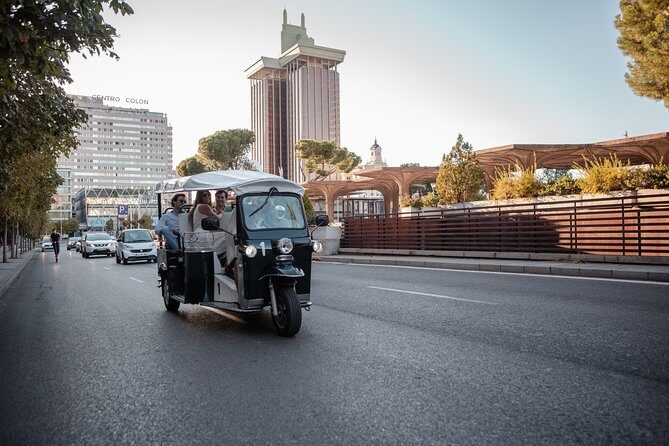
This private, 100% electric ride gives you an easy overview of Madrid while your guide ties the landmarks together with stories. If you end up with guides like Juli or Carlos, the pacing stays light and the explanations stay clear, so you’re not stuck staring at a map.
I really like the mix of sights on the route: big “wow” monuments, major museums from the outside, and church stops where you can actually step inside. A standout feature is the built-in rhythm of short walks plus time to snap photos without dragging your group through ticket lines.
One thing to consider: photo stops and the route are pre-set, so you can’t swap them on the fly. If you’re the type who wants to wander every alley for an extra hour, this isn’t that kind of tour.
In This Review
- Key takeaways before you book
- First-day Madrid momentum from an electric eco tuk tuk
- What makes this tour feel private: groups, tuk-tuk setup, and guides
- The route start at Plaza de Oriente: finding the eco tuk tuk meeting spot
- Atocha Station and the Spanish Courts: architecture you can actually picture
- Covered markets and the food-story stop
- Prado area and art big names: orientation without the museum marathon
- Los Jerónimos and the church details you’ll actually notice
- Puerta de Alcalá, Neptune, and Cibeles: neoclassical Madrid in three icons
- Barrio Salamanca’s streets and Bernabéu: modern Madrid without the chaos
- Plaza de Colón, Discovery Gardens, and the National Library of Spain
- Banco de España and Plaza de Santa Ana: power meets daily life
- San Francisco el Grande and Almudena Cathedral: religious Madrid that feels accessible
- Royal Palace and Campo del Moro: the “official Madrid” zone
- Debod Temple: a free Egyptian moment in the final stretch
- Price and value: what $28.67 per person buys you in real time
- Logistics that matter: fixed photo stops, weather, and timing
- Who this tour is for (and who should pick another plan)
- Should you book the Madrid Eco Tuk Tuk private tour?
- FAQ
- How long is the Madrid eco tuk tuk tour?
- Is this tour private, and is it offered in English?
- What kind of vehicle is used and are comfort items included?
- Where do I meet the guide and how do I find it?
- Are children allowed?
- Can I cancel for a full refund?
Key takeaways before you book
- Electric and private: your group rides in your own eco tuk tuk setup, max 4 passengers per tuk-tuk.
- Big hits in ~3 hours: you get an orientation loop that touches central landmarks and beyond.
- Winter comfort matters: blankets and protective layers help when wind or chill shows up.
- No queue pressure: the tour starts without waiting, using pre-selected stops for photos.
- Churches and monuments with context: your guide points out details most people miss while passing by.
First-day Madrid momentum from an electric eco tuk tuk
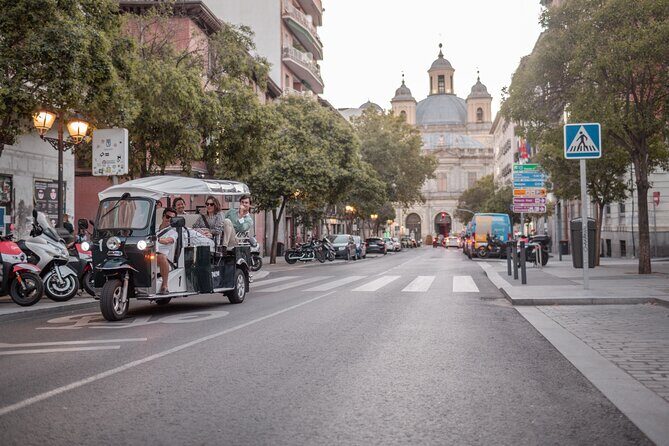
Madrid is spread out enough that your “first day plan” can go sideways fast. This tour is designed to stop that stress. You hop into a private eco tuk tuk and roll past the city’s most important landmarks in a way that feels more relaxed than a bus and less exhausting than walking the same ground.
The “local guide” part is what makes the ride work. You’re not just going from photo spot to photo spot. You get quick context for what you’re seeing, like why the Spanish Courts building sits on older ground, or why the Puerta de Alcalá has such strong design ideas behind it.
You can also read our reviews of more guided tours in Madrid

What makes this tour feel private: groups, tuk-tuk setup, and guides
It’s a private tour/activity, meaning only your group participates. That matters because you’re not listening over other languages or adjusting your pace around strangers.
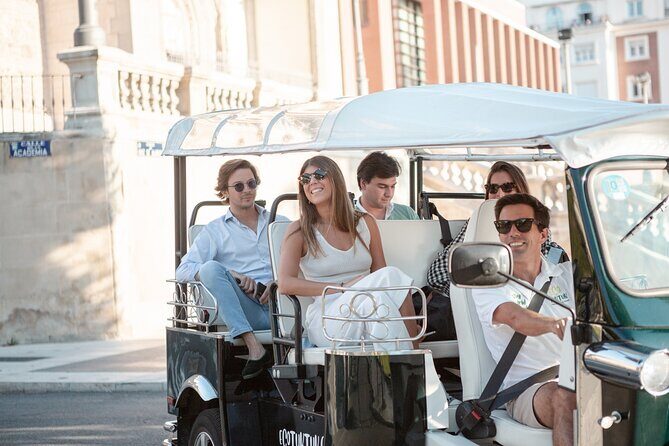
The vehicle setup is also practical: tuk-tuks are reserved for your group, and the price depends on how many tuk-tuks are legally needed (with a max of 4 passengers per tuk-tuk). So if you’re traveling with teens or multigenerational family members, you’re less likely to feel cramped.
Guides in this program vary, but the consistent theme in the experience is energy and pacing. Names you might run into include Jaime, Juli, Lucia, Carlos, Manuel, Gustavo, and Arturo. If you get one of the guides who leans into humor and quick historical tidbits, the tour can feel like a fun introduction rather than a school lecture.
The route start at Plaza de Oriente: finding the eco tuk tuk meeting spot
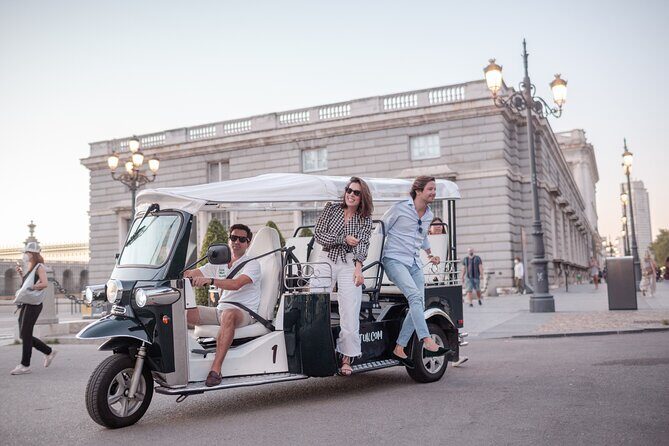
Most tours start at a hotel. This one starts at a landmark. You meet at C. de Bailén, 4, Centro, 28013 Madrid, right by the Royal Palace area, at the underground bus station in Plaza de Oriente.
The address can be confusing because there’s no obvious street number 4 at that spot. The easy workaround: use Google Maps for Calle Bailén 4 or search for Puerta del Príncipe. Look for the stairs to the underground station right opposite the gate, then follow the Eco Tuk Tuk signage once you’re there.
If you have mobility needs, don’t guess. The meeting point can involve stairs, but the company says you can request help so they can coordinate elevator access.
Atocha Station and the Spanish Courts: architecture you can actually picture
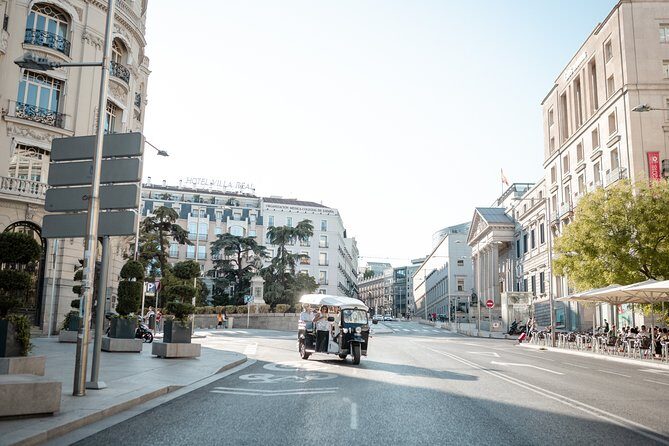
Two of the stops early on teach you how to “read” Madrid from the street.
First up is Atocha Station, a major railway complex near Plaza del Emperador Carlos V. It’s described as the busiest station in Spain and one of the busiest in Europe. Seeing it early helps you understand how Madrid moves: trains are part of the city’s daily rhythm, not just a novelty.
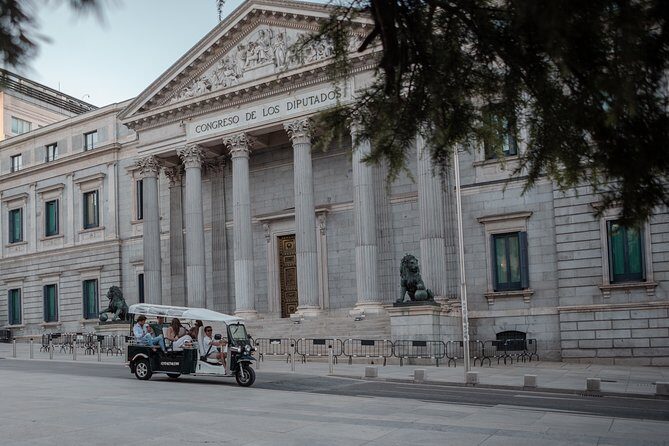
Next comes the Palace of the Spanish Courts. This building is tied to older history because it was built on the site of a former convent used as Congress seating between 1834 and 1841. Even if you never step inside, you can appreciate the main facade details: the neoclassical portico with six Corinthian columns, and the lions flanking the entrance that connect the architecture to Spain’s past through iron cast from captured cannons.
The guide also points out the session room and other major spaces by reputation, so when you later see photos online or read about it, it’ll click faster.
Covered markets and the food-story stop
Madrid’s city center has places that feel like “daily life,” not just sights. The tour includes a covered market dating from around 1916, with local food, delicatessen stalls, and events in an elegant setting.
This stop is useful even if you don’t plan a big meal during the tour. It gives you a baseline for where to snack, what kinds of products show up, and what neighborhoods lean local versus tourist.
If you like to eat your way through a city, this is a good way to switch gears from monuments to something human-scale.
You can also read our reviews of more private tours in Madrid



Prado area and art big names: orientation without the museum marathon
Art lovers sometimes worry that a short tour won’t help. The good news: this tour is built for orientation. It includes the kind of stops that set you up to visit later with a plan.
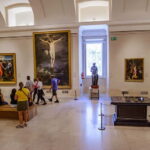
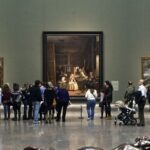
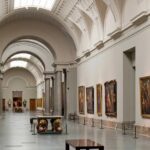
The museum stop on the route is the Prado, and the context given focuses on European painting from the 16th to the 19th centuries. Names you’ll hear tied to the collection include Velázquez, El Greco, Goya, Tiziano, Rubens, and El Bosco, plus many others. The point isn’t to “teach an art history class” in three hours. It’s to help you understand the scale and where to start if you buy tickets separately.
One practical tip that came up: the Prado is free after 6pm, so if you want a low-cost museum moment, plan your visit for later in the day.
Los Jerónimos and the church details you’ll actually notice
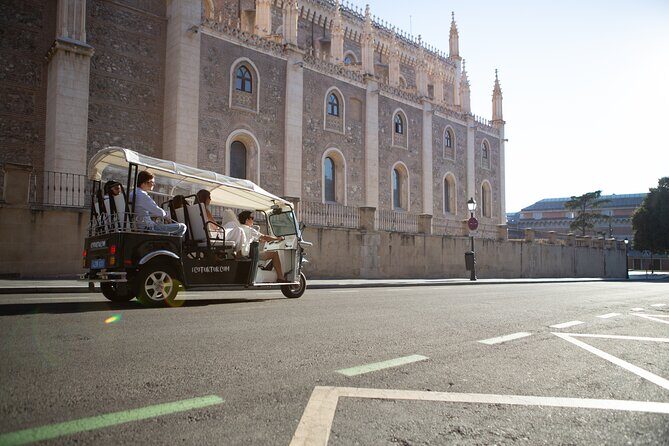
Right near the Prado area, you’ll pass by (and in many cases have a chance to look closely at) the Parish Church of San Jerónimo el Real, popularly called Los Jerónimos. It’s described as late Gothic with Renaissance influence from the early 16th century, with multiple restorations over the centuries.
What I like about this stop is how it turns into a story about royal Spain. The church has a special relationship with the kings of Spain, including royal investiture and major events like the wedding of Alfonso XIII. If you’ve ever wondered why certain buildings feel “official” in Europe, this is a clear example.
Even when the tour doesn’t give you tons of time inside, the guide’s framing helps you spot what matters: the connection between architecture and power, and why the building’s significance lasted long after its original function changed.
Puerta de Alcalá, Neptune, and Cibeles: neoclassical Madrid in three icons
This part of the tour is basically a crash course in neoclassical style, and the guides don’t just point. They explain.
At Puerta de Alcalá, you learn the basics that make the monument feel less random. It was built on mandate of Carlos III to replace an earlier gate, inaugurated in 1778, and designed by Francesco Sabatini. The arc is described as a granite triumphal form in neoclassical style, and the details get even better: it has five openings instead of the usual three, and the decorations differ between the city-facing and outer facades. That means there are layers to what you’re looking at, even if you’re standing on a busy street.
Then you move to Neptune’s fountain in Plaza de Cánovas del Castillo, a neoclassical fountain proposed in 1777, with construction starting in 1782 and finishing in 1786. It’s one of those spots that’s easy to photograph because it’s centered and monumental. The guide helps you connect the fountain to the city’s roundabout geography and design.
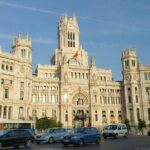
Finally, Cibeles is the “sports celebration” side of Madrid. The fountain represents the Roman goddess Cibeles symbolizing land, agriculture, and fertility, shown on a car pulled by two lions. The guide also connects it to Real Madrid fans, since the team’s titles get celebrated here. It’s a great example of how ancient symbolism keeps living in modern street culture.
Barrio Salamanca’s streets and Bernabéu: modern Madrid without the chaos
After the older core sights, the tour shifts to areas many first-timers skip because they feel “far” or “too specific.”
You’ll ride through the main streets of Barrio Salamanca, including Velázquez, Ortega y Gasset, and Serrano. This helps you picture the city’s shopping and upscale vibe without committing to a long walk.
Then the route includes the Santiago Bernabéu stadium area. The tour info notes it was inaugurated on December 14, 1947, and the current capacity is listed as 81,044 spectators. Even if you’re not catching a match, seeing it on the route is smart if you want a realistic feel for how big and central football culture is.
Plaza de Colón, Discovery Gardens, and the National Library of Spain
This segment brings in a different kind of Madrid: civic monuments, parks, and grand institutions.
You’ll see the Christopher Columbus monument in Plaza de Colón. It’s a white marble neo-Gothic sculpture built in 1885 by Jerónimo Suñol, measuring 17 meters, tied to the wedding celebration between Alfonso XII and María de las Mercedes de Orleans. The guide’s explanation helps it stop being just a traffic-splashed landmark and becomes a statement of how Spain wanted to frame its identity in the 1800s.
Nearby is the Gardens of Discovery, opened in 1970, with sculptures including one dedicated to the discovery of America. Then the route passes the Cultural Center of Villa Fernán Gómez in the basement area.
A stop at the National Library of Spain (BNE) rounds things out. The tour highlights the library’s role in preserving Spain’s bibliographic heritage: about thirty million publications since the beginning of the 18th century, spanning books, magazines, maps, prints, drawings, scores, and brochures. You get a sense of the scale and purpose without needing to schedule a full museum day.
Banco de España and Plaza de Santa Ana: power meets daily life
Next comes a strong contrast: an institutional building outside with big “Spain matters” energy, then a more human open plaza.
The Banco de España stop notes the building’s goal was to provide the National Bank with a seat aligned with its function, including the single issuance of coins and bills across Spanish territory. The interior visit is said to be limited to groups from educational centers and universities, and sometimes exceptional non-profit cultural or associative entities—so plan to focus on the exterior and the architecture story.
Then you get Plaza de Santa Ana, described as an open space in the Cortes neighborhood that dates from 1810. It’s the kind of plaza where Madrid feels like Madrid: less about explaining monuments and more about watching the city in motion.
San Francisco el Grande and Almudena Cathedral: religious Madrid that feels accessible
If your time is tight, churches can be a smart choice because the payoff is huge and often free or easier to enter than museums.
The tour includes the Royal Basilica of San Francisco el Grande (officially Basilica of Our Lady of the Angels). It’s a Catholic church in Madrid’s Palacio neighborhood within the historic center.
Then comes Almudena Cathedral, called the most important religious building in Madrid. The cathedral was consecrated June 15, 1993 by Pope John Paul II, and it’s described as the first consecrated cathedral outside Rome. There’s also an Almudena Cathedral Museum with multiple rooms that cover mosaics to episcopal shields and ornament.
In plain terms: if you only do one religious stop on a short visit, this is one to prioritize.
Royal Palace and Campo del Moro: the “official Madrid” zone
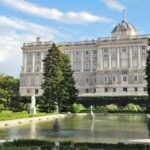
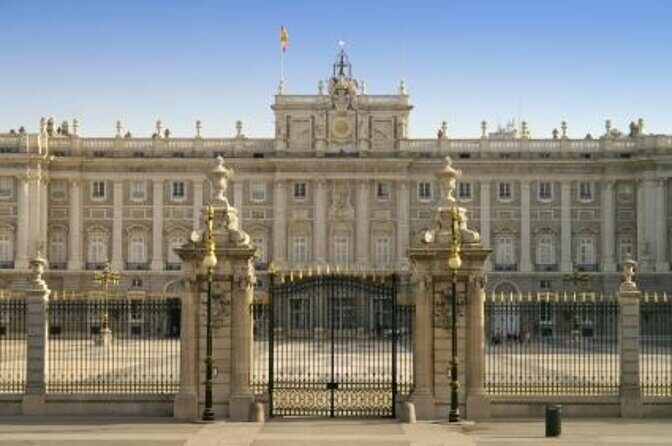
The tour ends up around the Royal Palace and its gardens. The Royal Palace (Palacio de Oriente) is also called Palacio de Oriente, and the construction began in 1738 with works lasting seventeen years. Carlos III set his habitual residence there in 1764.
What I like here is that you don’t just see the palace. You also get the garden context. The Campo del Moro is described as about twenty hectares, stretching from the western facade of the Royal Palace to the promenade of the Virgin of the Port, and it’s declared of historical-artistic interest.
This is a good part of the tour for photos because the palace sits in a visual frame that instantly reads as power and planning, not improvisation.
Debod Temple: a free Egyptian moment in the final stretch
The last stop is Templo de Debod. This is a building from ancient Egypt currently located in Madrid, positioned west of Plaza de España next to Paseo del Pintor Rosales, on a hill where the Mountain Barracks was located.
It’s also listed as a short stop—about 15 minutes—with free admission. That makes it a great closer if you want something different from the European-only feeling that can dominate a first pass through the center.
Price and value: what $28.67 per person buys you in real time
At $28.67 per person, you’re not paying for a single attraction. You’re paying for transport plus a local guide plus comfort extras.
Here’s what’s included that affects value:
- Start without queues or waiting
- A private ride for your group only
- A pre-selected set of photo stops
- Blankets and protective layers against wind and rain
- Mobile ticket convenience
If you were trying to “DIY” the same loop, you’d spend time hopping between transit, walking extra blocks, and still likely miss the connections a good guide points out. The best value tends to show up when this is your first Madrid activity. You’ll come away knowing where the big landmarks sit, which makes your later museum tickets and neighborhood choices much easier.
Logistics that matter: fixed photo stops, weather, and timing
This tour runs in rain or heat. Cancellation only happens under extreme conditions. That’s good for planning, but it also means you’ll want to dress with layers and use the included comfort items. Blankets and protective layers are part of the package, which is a big deal in winter when the wind cuts.
A timing note: if you’re late, the activity may be reduced based on lost time. If you’re delayed more than 15 minutes and there’s no way to catch up, the tour cancels and there’s no refund listed.
Also, the route and photograph moments can’t be changed. If you want spontaneous detours, you’ll need another day for that.
Who this tour is for (and who should pick another plan)
This tour is a strong fit if you:
- Want a first-day orientation
- Have limited time and hate wasting it on transit
- Like guided stories but don’t want nonstop walking
- Travel with mixed ages (the tour info says vehicles are suitable for older people and drivers help them get on)
It may not be your best match if you:
- Want long, slow museum time or hours inside multiple sites
- Need the route to follow your exact must-see order
- Prefer to wander freely instead of sticking to pre-set photo stops
Should you book the Madrid Eco Tuk Tuk private tour?
Yes, if you want an efficient, comfortable introduction to Madrid that balances major landmarks with real context. The combination of a private electric ride, pre-selected stops, and guide storytelling makes it a smart use of a half-day to get your bearings fast.
I’d especially book it early in your trip, then follow up later with the specific places that grabbed you most: for many people, that ends up being the Prado area, Almudena Cathedral, and one or two neighborhood walks in Barrio Salamanca.
If you’re the planner type who wants flexibility, go in knowing the stops are fixed. Then the tour becomes less about customizing and more about enjoying a well-paced highlights circuit without the usual city stress.
FAQ
How long is the Madrid eco tuk tuk tour?
The tour runs about 2 to 4 hours, and it’s described as taking roughly three hours.
Is this tour private, and is it offered in English?
Yes. It’s a private tour/activity with only your group participating, and it’s offered in English.
What kind of vehicle is used and are comfort items included?
You ride in a 100% electric and sustainable vehicle. Blankets and protective layers are provided to help in cold or windy weather.
Where do I meet the guide and how do I find it?
Meet at C. de Bailén, 4 in Centro, near Plaza de Oriente and by the underground bus station right next to the Royal Palace. If the address number is tricky, search Calle Bailén 4 or Puerta del Príncipe on Google Maps, then look for the Eco Tuk Tuk signage.
Are children allowed?
The minimum age is two years, and babies are not allowed. There is also a minimum weight requirement of 9 kg.
Can I cancel for a full refund?
Free cancellation is available up to 24 hours in advance for a full refund. If you cancel less than 24 hours before the start time, the amount you paid is not refunded.