REVIEW · MADRID
Madrid Express Tour with Local Guide in Eco Tuk Tuk Private
Book on Viator →Operated by Eco Tuk Tuk - Spain · Bookable on Viator
Madrid, zipped up fast.
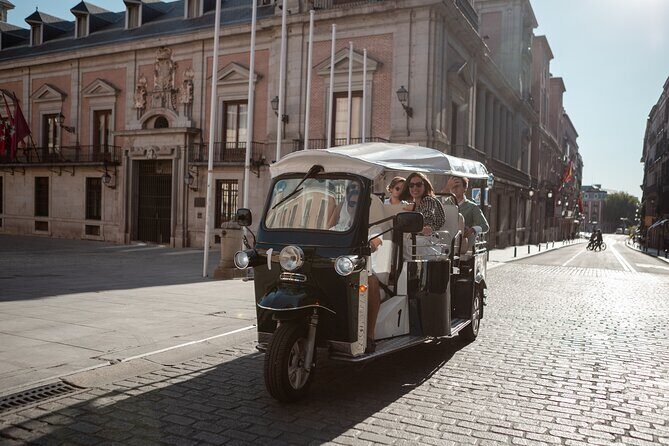
This Madrid Express tour uses an eco electric tuk tuk to get you comfortably around central Madrid, with a local guide steering the story and pre-selected photo stops built into the route. It is designed for first-timers who want the big landmarks without getting stuck in traffic, and it keeps you warm with winter blankets when the city feels chilly.
What I love most is how easy it is to start seeing Madrid right away—no queues or waiting—and how comfortable the ride feels even in bad weather, thanks to blankets and protective layers for wind and rain. You also get a private vehicle for your group, which makes it simpler to ask questions and adjust at the pace of your own party.
One possible drawback: the tuk tuk is open up top, so on very hot days it may feel too warm, and from the seating angle you might not always be able to look straight up at tall buildings without shifting around.
In This Review
- Key things to know before you go
- Eco electric tuk tuk: the smart way to see Madrid fast
- Meeting at Plaza de Oriente: finding Puerta del Príncipe without stress
- The Madrid Express route: what you’ll see and why it works
- Food market origins: the 1916 market that became Madrid’s first gastronomic market
- Atocha station: Madrid’s busiest rail hub as a city landmark
- Palacio de las Cortes: lions, iron, and the power of details
- Cibeles and Neptune: the sports square rivalry you can feel
- Prado Museum spotlight: the artists that define European painting
- San Jerónimo el Real: the church that royalty treated like its own retreat
- Puerta de Alcalá: Sabatini’s triumphal arch with five openings
- Banco de España: a grand building you mostly see from outside
- Plaza de Santa Ana: a classic open space in the Cortes neighborhood
- Almudena Cathedral: consecrated in 1993 and a major Madrid landmark
- Royal Palace area: Palacio de Oriente and the Campo del Moro gardens
- Guides in action: what makes the storytelling feel worth it
- Price and value: is $28.67 per person a good deal?
- Practical drawbacks to plan around
- Who should book this Madrid Express tour?
- Should you book the eco tuk tuk Madrid Express?
- FAQ
- How long is the Madrid Express Eco Tuk Tuk tour?
- Is the tour in English?
- Is this tour private?
- What’s included in the price?
- What is not included?
- Where do I meet the guide?
- Do I need to worry about weather?
- Is there a minimum age or weight requirement?
- Can I change the route or request extra stops?
- What’s the cancellation policy?
Key things to know before you go
- Eco electric tuk tuk ride that’s better for comfort and convenience than big tour buses in tight areas
- No-queue start that helps you make real sightseeing time, not just waiting time
- Blankets and rain protection so weather is less of a deal-breaker
- Private setup with up to 4 passengers per tuk tuk, so your group stays together
- Photo-stop planning so you spend less time guessing where to stop and more time looking
- Guides in clear English who connect monuments to real-life Madrid streets and neighborhoods
Eco electric tuk tuk: the smart way to see Madrid fast
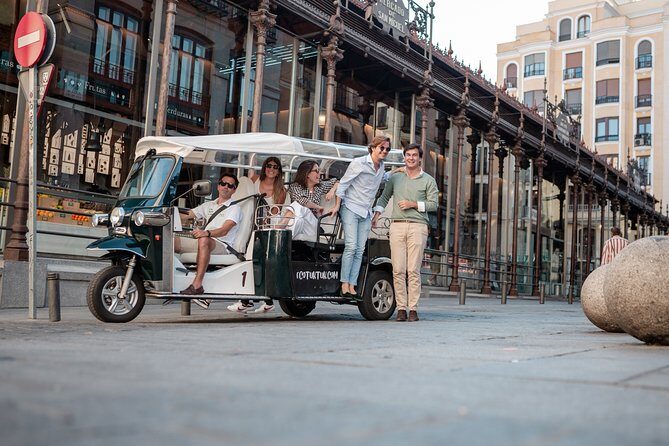
If you want a quick, human-sized introduction to Madrid, the eco tuk tuk is a great match. You’re not trapped on a rigid bus route. You can glide through neighborhoods and landmark areas in a way that feels more local—plus, the vehicle is 100% electric and sustainable, which is a nice bonus if you care about low-emissions travel.
The other key advantage is pacing. A big highlights tour often turns into a “here-we-go-again” blur. Here, the stops are planned for photos and context, so you get just enough time at the places that matter: architecture, plazas, and the cultural landmarks you’ll keep seeing later as you explore on your own.
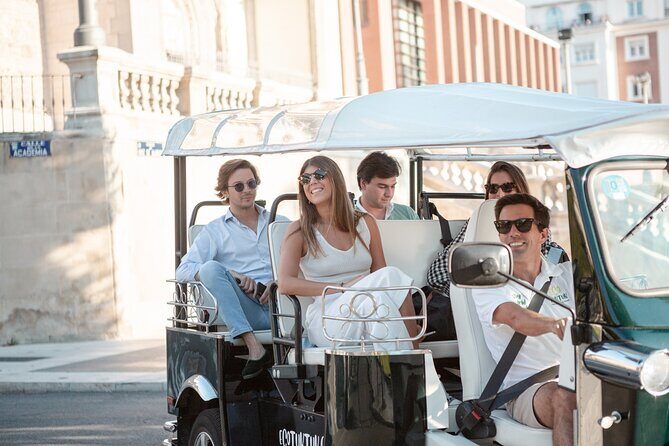
And because this is a private vehicle setup for your group, you don’t have to shout over other languages or stare at the back of someone’s head. You’re in charge of your own questions, even on a short day.
You can also read our reviews of more guided tours in Madrid

Meeting at Plaza de Oriente: finding Puerta del Príncipe without stress
Your starting point is at C. de Bailén, 4, Centro, 28013 Madrid, but the practical detail is that the pickup is at the bus station (underground) of Plaza de Oriente, right next to the Royal Palace area.
The spot is linked to the Puerta del Príncipe entrance. If you plug in Calle Bailén 4, you might not see a clear number 4. Instead, search for Puerta del Príncipe in Google Maps—the pin should match the pickup zone. Walk toward the stairs near that gate; you should see the Eco Tuk Tuk signage guiding you to the exact entry point.
If you want to be extra calm, keep the contact options handy. You can message or call via WhatsApp at +34 696 99 78 89 at any time. That matters because the tour can get cut short if you’re delayed, and a delay over 15 minutes can cancel the activity with no refund.
The Madrid Express route: what you’ll see and why it works
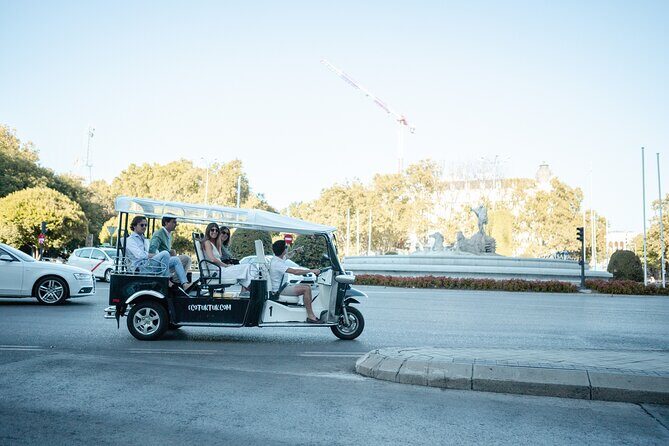
This is built for “I have limited time” travelers. You’ll move through the most central Madrid areas, touching classic sights from multiple angles—monuments, stations, plazas, and major institutions—so you can understand how Madrid pieces itself together.
The tour also avoids the usual sightseeing trap: arriving at your first landmark only to find you’re stuck in lines, crowds, or timing problems. This one is set up so you start without queues or waiting, which helps a lot if you’re juggling museum plans later.
Expect the ride to include stops where your guide can explain what you’re seeing, not just point and move on. And yes, it can run in rain or heat; the tour only cancels under extreme conditions.
Food market origins: the 1916 market that became Madrid’s first gastronomic market
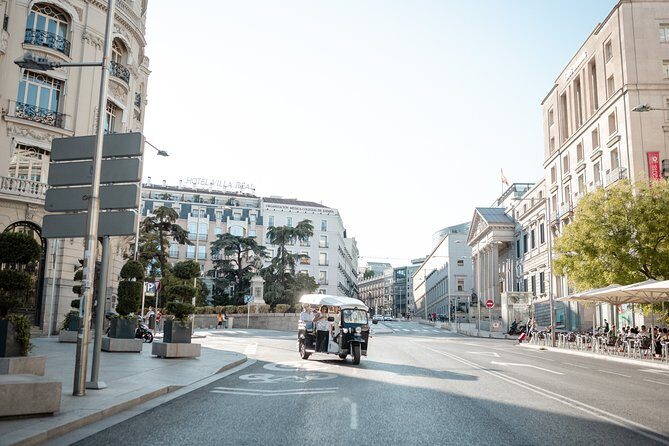
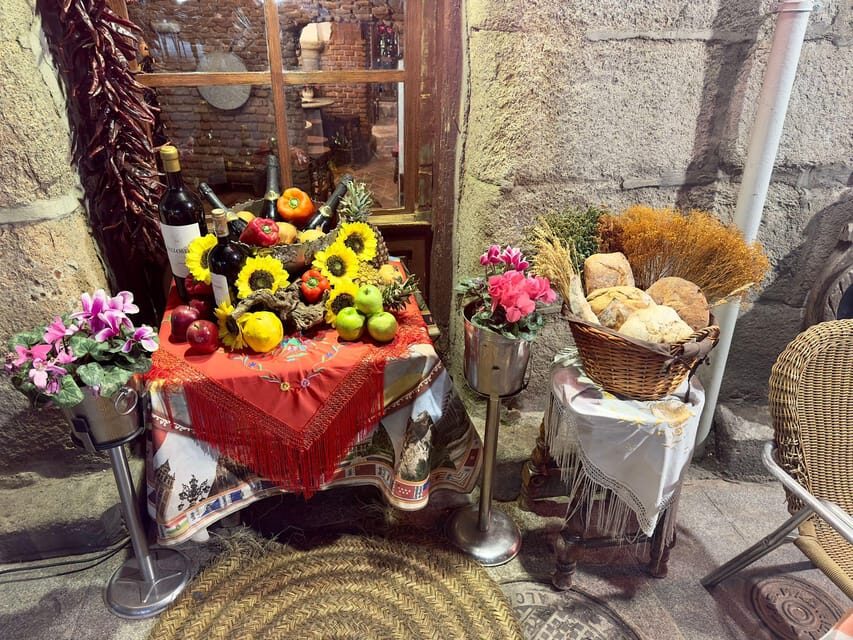
One stop takes you to a food market that opened in May 1916. It later became the first gastronomic market in Madrid in May 2009, and it went through a consolidation phase of much of its food focus around 2018.
Why this matters on an express tour: markets are how you learn a city’s daily rhythm fast. Even if you do not eat right then, it helps you connect Madrid’s food culture to real places you can revisit later. You’ll also get a better sense of how Madrid mixes tradition with modern dining energy—something you’ll notice again in the neighborhoods you explore after the tour.
Possible drawback: in an express format, this is more of a context and photo moment than a deep food experience. If you want tastings and a long market wander, you’ll likely want a separate food-focused activity afterward.
Atocha station: Madrid’s busiest rail hub as a city landmark
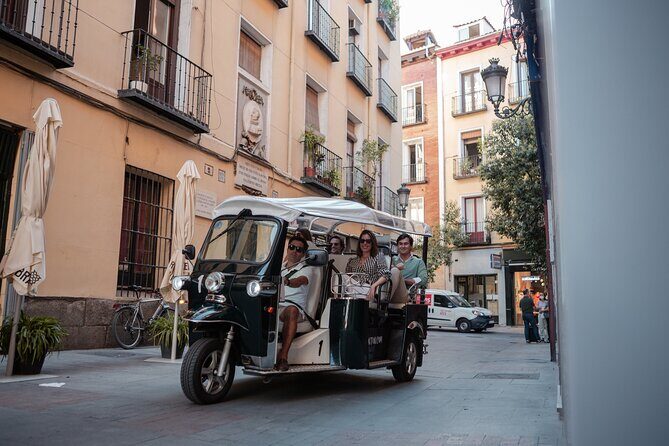
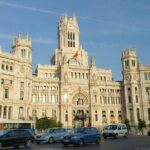
Next up is Atocha station, described as a railway complex near Plaza del Emperador Carlos V and the busiest station in Spain, and one of the main hubs in Europe.
On a short tour, it’s smart to include a station like this. It’s not only a transportation stop—it’s a way to understand how Madrid moves people in real life. You’ll also see a very “Madrid” contrast: monumental city history next to the modern churn of commuters and trains.
What you’ll get: a guided look at the station as a hub, plus enough context to place it on your mental map. You’ll feel more oriented when you later plan trips to other cities, because Atocha is usually the anchor point for those routes.
You can also read our reviews of more private tours in Madrid




Palacio de las Cortes: lions, iron, and the power of details
The tour includes the Palace of the Spanish Courts (Palacio de las Cortes). The site originally held a convent, and it became the seat of Congress in the early 1800s. The facade includes a neoclassical porch with six Corinthian columns, a triangular pediment with reliefs, and emblematic lions flanking the entrance.
Here’s a standout detail: those lions are linked to captured iron from cannons in Africa—an unusual, specific origin story that makes the building feel less like a generic government block and more like a physical record of Spanish history.
You’ll also hear how the bronze door under the pediment opens only on very marked occasions, plus references to interior features like the Session room and the “lost steps” conference room.
Possible drawback: if a tall entrance is what you really want to study, the tuk tuk seat position may limit how long you can comfortably look upward. You can still take it all in; just plan to get the facts from your guide rather than trying to visually inspect every carving from the vehicle angle.
Cibeles and Neptune: the sports square rivalry you can feel
Then you get the famous Plaza de Cibeles pairing. The guide points out the Greek mythology connections: Cibeles (the land, agriculture, fertility goddess) and the rival Neptune counterpart, with Atlético fans celebrating in Cibeles’ square and Real Madrid fans celebrating at Cibeles as well—an intense sports symbolism that makes the area feel bigger than its size.
You’ll also learn the urban-design story: in the original planning (linked to Ventura Rodríguez), the fountains faced each other on Paseo del Prado. Later, at the end of the 19th century, they were restructured and moved into the centers of Plaza de Cibeles and the counterpart Cibeles and Cánovas del Castillo squares.
Why this is valuable: it turns a photo stop into a “Madrid codes” lesson. Once you know the sports symbolism, you start noticing it everywhere—posters, bars, jerseys, and even casual conversations.
Prado Museum spotlight: the artists that define European painting
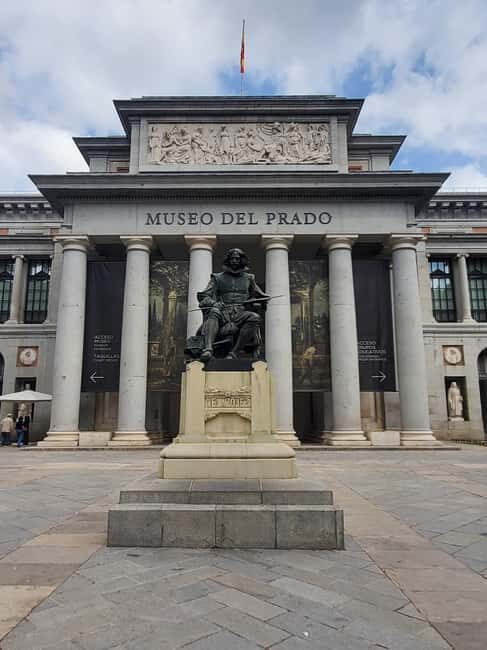
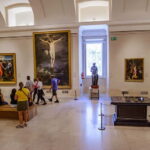
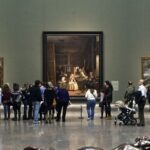
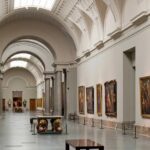
A stop at the Prado Museum is described as one of the world’s most important European painting museums, with a concentration of major masters.
You’ll hear the names that anchor the collection: Velázquez, El Greco, Goya (with Goya highlighted as the most widely represented), Titian, Rubens, and El Bosco, plus major supporting artists like Murillo, Ribera, Zurbarán, Fra Angelico, Rafael, Veronese, Tintoretto, Patinir, Antonio Moro, Van Dyck, and Poussin.
The big value here is orientation. If you plan to visit the museum later (or if you only have time for the outside), this guide framing helps you understand what you’re looking for and why the Prado matters.
Possible drawback: this tour stop is not the same as an inside museum ticket experience. You’re getting the context and key names, not a full gallery walk.
San Jerónimo el Real: the church that royalty treated like its own retreat
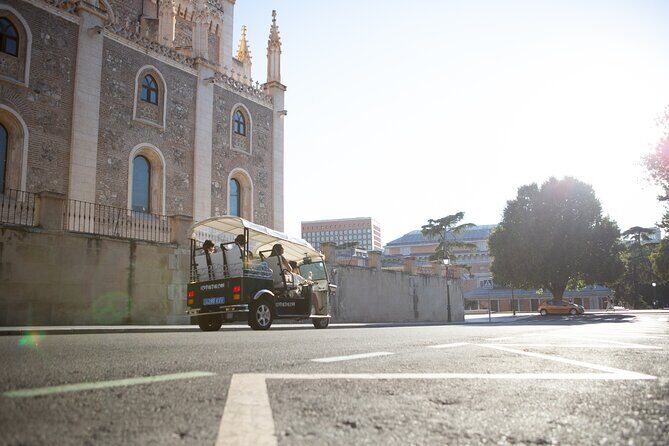
The tour includes the church known popularly as Los Jerónimos, officially the Parish Church of San Jerónimo el Real, located next to the Prado Museum.
It’s late Gothic with Renaissance influences from the early 1500s, and while little of the original building remains untouched, it has been remodeled and restored repeatedly. The royal connection is the story: ordered by the Catholic Monarchs, used as a spiritual retreat for monarchs, and serving royal investiture roles in the absence of a cathedral.
A specific detail to remember: the wedding of Alfonso XIII was held here, and the great stairway leading to the door was built in 1906.
Why it works on an express route: this stop adds “Madrid’s royal layer” to the city picture. It also helps you connect Prado-area architecture to the broader Spanish political and religious story.
Puerta de Alcalá: Sabatini’s triumphal arch with five openings
You’ll also see the monumental Puerta de Alcalá, commissioned by Carlos III to replace an earlier 16th-century door, and inaugurated in 1778.
Designed by Francesco Sabatini, it’s a neoclassical granite triumphal arch—one of the first built in Europe after the fall of the Roman Empire. The guide also connects it to later European monuments like the Arc de Triomphe in Paris and the Brandenburg Gate in Berlin.
One of the fun details that your guide will likely emphasize: unlike some of its famous cousins, this one has five openings instead of the usual three. The two facades offer different decoration styles, so what you notice depends on the angle you approach from.
Why it’s a great stop: it’s an iconic piece of Madrid’s “classical city” face. On a short day, you want at least one big symbol like this—and this gate delivers.
Banco de España: a grand building you mostly see from outside
Another stop highlights the Banco de España building, described as an ornate structure awarded at the National Exhibition of Fine Arts in 1884. It was built to give the National Bank a seat more in line with its national importance, including functions tied to coins and bills across Spain.
Here’s the key practical point: the interior can only be visited by groups from educational centers and universities, with exceptional access for non-profit cultural and associative entities.
On your tuk tuk tour, you’ll mainly get the exterior impact plus guide context. It’s still worthwhile because it reinforces how Madrid’s financial power and architectural grandeur were linked.
Plaza de Santa Ana: a classic open space in the Cortes neighborhood
The tour then heads to Plaza de Santa Ana, an open square in the Cortes neighborhood in central Madrid, dating back to 1810 and later shaped by multiple urbanization phases.
This kind of square stop is useful even when time is tight. It’s a breathing space. It also helps you understand how the city’s streets “flow” around major public rooms, so you can navigate later without feeling lost.
Almudena Cathedral: consecrated in 1993 and a major Madrid landmark
The Almudena Cathedral is the most important religious building in Madrid, and it was consecrated on June 15, 1993 by Pope John Paul II—notably the first consecrated cathedral outside Rome.
Your guide can connect the cathedral to the museum-side context too, since there’s an Almudena Cathedral Museum with mosaics, episcopal shields, and story objects spread across multiple rooms.
On an express tour, plan to treat this as a major visual moment more than a museum plan. Still, the consecration story is one of those facts that makes the building feel alive and modern, not just old stone.
Royal Palace area: Palacio de Oriente and the Campo del Moro gardens
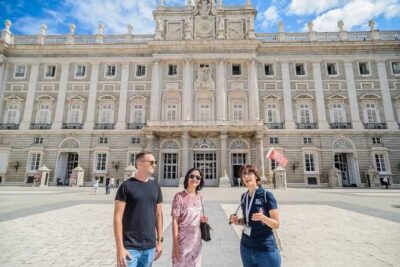
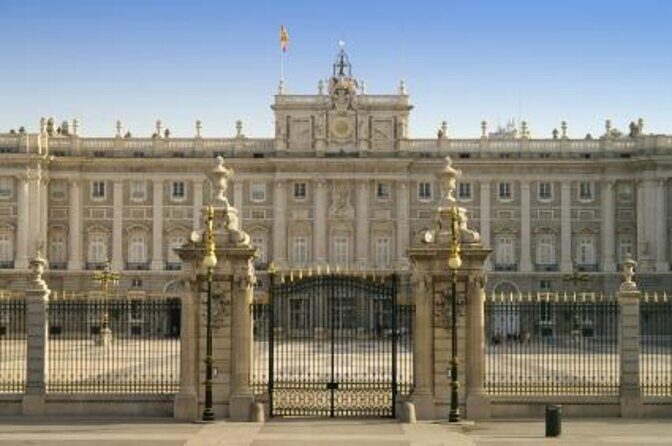
The tour ends back near the Royal Palace area. You’ll hear that the Royal Palace—also called Palacio de Oriente—is used for receptions, ceremonies, and official events.
Construction began in 1738, with work lasting 17 years, and shortly after completion, Carlos III established his habitual residence there in 1764. It also notes the palace sits on the former Palace of the Austrias site, destroyed in a Christmas Eve fire in 1734.
The palace is surrounded by Campo del Moro gardens and the Sabatini gardens. Campo del Moro can be visited during the day, which is a nice follow-up plan if you want to extend the experience after the tuk tuk ride.
Why this matters: this is Madrid’s “you can see it from everywhere” power center. Even if you already planned to visit later, this gives you a quick mental layout so you know where to go when you get off the vehicle.
Guides in action: what makes the storytelling feel worth it
The best part of this tour is how the guide turns landmarks into a connected story. In English-language experiences shared with the provider, guides including Juan, Esther, Carlos, Lucia, Fernando, and Hector are singled out for being friendly, professional, and clear.
You’ll especially feel it if you like asking questions. Because it’s private for your group, your guide can tailor explanations to what you care about—architecture, royal Spain, sports symbolism, or why certain buildings look the way they do.
Also, the ride style helps: you get lots of vehicle movement with smart stops, so you’re not stuck in one location for too long unless the stop itself is the point.
Price and value: is $28.67 per person a good deal?
At $28.67 per person, this pricing can feel like a bargain when you compare it to the cost of museum admissions plus a timed tour that covers multiple landmarks.
Two things make the value make sense:
- You’re paying for speed plus local interpretation, not just transportation. No queues, planned photo stops, and a guide who ties sights together.
- It stays private. The tuk tuks are reserved for your group only, with the legal maximum of 4 passengers per tuk tuk, so your party isn’t mixed with strangers.
The main value risk is the same one that applies to any express tour: if you’re hoping for deep time inside major buildings, you may feel shorted. This works best as the “get oriented fast” layer of your Madrid trip.
Practical drawbacks to plan around
A few real-world considerations can affect how great the experience feels:
- Heat can be tough. One note calls out that hot days are not the best match for this open-air style.
- Looking up is harder from the tuk tuk top frame, especially at ornate facades. You may need to shift to see upper details.
- Route tweaks happen. Closed streets or demonstrations can change the itinerary. Also, if you arrive late, the tour may be reduced based on lost time.
None of this ruins the concept, but it does mean you should treat it like a guided city loop. Bring a light layer for cold weather and plan to enjoy the facts and overall flow more than close-up architectural study.
Who should book this Madrid Express tour?
You should book if:
- You’re a first-timer and want the major landmarks quickly.
- You prefer asking questions with a local guide instead of just reading plaques.
- Your schedule is tight, and you want one practical day plan that doesn’t depend on perfect traffic conditions.
You might skip or pair it differently if:
- You want long museum time and deep interior visits.
- You travel on a day you expect extreme heat and you dislike being exposed to sun or warmth.
Should you book the eco tuk tuk Madrid Express?
If you want an easy, central, guided overview with a fun vehicle that reaches places big buses sometimes can’t, I think this is a strong buy. It’s especially good for a first day, after an early arrival, or whenever you want to build a mental map of Madrid quickly.
Book it if you’ll use the guide for orientation and you’re happy with short stops rather than full deep-dive museum time. Skip it (or plan a different style of tour) if you’re extremely sensitive to heat or you’re hoping to study towering facades from the exact right angle.
FAQ
How long is the Madrid Express Eco Tuk Tuk tour?
The duration is listed as 1 to 4 hours (approx.) depending on the option you book.
Is the tour in English?
Yes. The tour is offered in English.
Is this tour private?
Yes. It’s a private tour/activity with only your group participating, and it includes a private vehicle reserved for your group only.
What’s included in the price?
Included items are an expert companion guide driver, a start with no queues or waiting, a 100% electric and sustainable vehicle, pre-selected stops for photographing, and blankets/protective layers against rain and wind.
What is not included?
The tour does not include tips to the driver guide, and it also does not include hotel pickup and drop-off or any transfers outside the tour route.
Where do I meet the guide?
You meet at C. de Bailén, 4, Centro, 28013 Madrid, but pickup is at the underground bus station of Plaza de Oriente, next to the Royal Palace, near Puerta del Príncipe.
Do I need to worry about weather?
Tours take place in rain or heat, and can only be cancelled under extreme conditions. Winter includes blankets and protective layers for comfort.
Is there a minimum age or weight requirement?
Yes. The minimum age is two (2) years, and there is a minimum weight required of 9 kg. Babies are not allowed.
Can I change the route or request extra stops?
No. The itinerary can vary only due to closed streets or demonstrations, but stops for photographs cannot be modified, and tours cannot be modified.
What’s the cancellation policy?
You can cancel for free up to 24 hours in advance for a full refund. If you cancel less than 24 hours before the start time, the amount paid is not refunded.